
Kotor Neighbourhoods and Their Character
Palaces within Kotor's walls often grew by joining older houses together. Dobrota's maritime estates combined a house, garden and landing place. Muo's waterfront retains stone houses and small landing places linked to its fishing past. In Skaljari, houses with gardens stand alongside apartment blocks with shared green spaces.
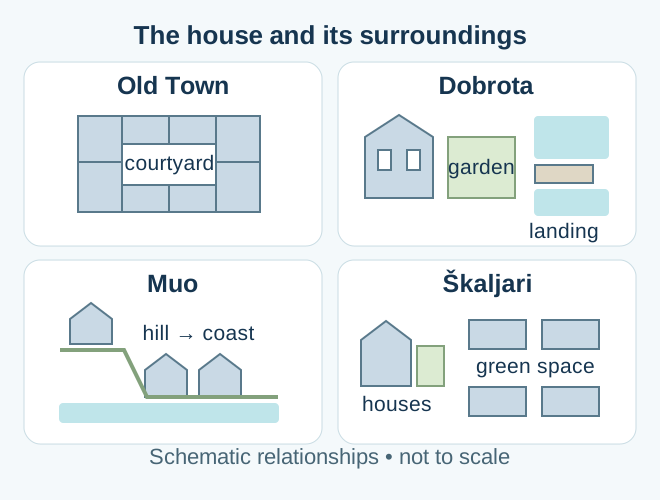
Living spaces in four neighbourhoods
- Old Town
- Courtyards inside city blocks
- Dobrota and Muo
- Houses and landing places by the sea
- Skaljari
- Houses and apartment complexes
Houses, the sea and the growth of settlements
The old palaces of Kotor and its coastal settlements served as homes and places of business, with goods stored on the ground floor. Muo's move towards the shore went hand in hand with a stronger reliance on fishing, while Skaljari grew with industry.
01Old Town
In the Old Town, houses form dense blocks surrounded by streets and squares. Behind some facades are internal courtyards with staircases and terraces. Noble families often enlarged their palaces by extending and joining older houses, so a single large building can contain sections from different phases of construction.
Pima Palace on Flour Square has just such a history. Its oldest section is inside the block, while the northern wing and the facade facing the square took shape later. In the courtyard are stone staircases and galleries (open passageways leading to the upper rooms). The ground floor contained vaulted rooms for storing goods.
The palace is still used for housing, and part of the ground floor houses the Gallery of Solidarity. Our guide to Kotor's attractions covers the gallery and other places to visit.
02Dobrota
Dobrota's old houses face the bay, and stone-walled courtyards lie between many captains' palaces and the shore. A house, garden and landing place formed one family's maritime estate. Goods were stored on the ground floor and in outbuildings, while the upper floors were used for family life and receiving guests.
Tripkovic Palace shows how extensive such a property could be. The house stands back from the shore on a raised garden platform, with a gateway bearing the family coat of arms in the boundary wall. On the seaward side, the estate included a ponta, a stone landing place, and a mandrac, an enclosed harbour for boats. Behind the house, terraced gardens extend up the slope.
Dobrota also grew beyond its old waterfront estates. Newer areas with houses and apartment buildings developed above the coastal row.
03Muo
Muo has retained a waterfront row of stone houses and small landing places linked to its fishing past. The older settlement stood higher on the slopes of Vrmac. Traces of houses, a cemetery and the Church of Saints Cosmas and Damian remain in that upper area, while later houses were increasingly built along the shore.
The move towards the sea went hand in hand with a stronger reliance on fishing, and fish were sold in nearby Kotor. Muo today also includes newer buildings on the hillside, beyond the old waterfront row.
A custom known as Rusalje, the blessing of the sea, is tied to this fishing heritage. After a service in the Church of the Blessed Virgin Mary Help of Christians, worshippers walked down to the landing place below it and prayed for fishers, seafarers and those lost at sea. The priest dipped a cross into the water, and boats and fishing gear were blessed.
04Skaljari
Skaljari has family homes with gardens as well as larger housing complexes with shared open spaces. Rakite is one of its residential areas: the buildings are grouped into blocks, with green spaces and parking areas between them.
Skaljari grew with industry, which occupied much of the lower ground towards the bay. Houses were also built on the surrounding slopes, mainly on separate plots. Older stone houses along Put prvoboraca street had outbuildings and gardens beside them.
Rakite was built during the large-scale reconstruction after the earthquake on Montenegro's coast, on the site of an earlier settlement known as Spadola. Outdoor spaces were provided alongside the apartments, including a basketball court and benches between the buildings.
Want to explore more of Kotor?
Keep exploring Kotor through local stories and guides to the city and its surroundings.
Continue planning your stay with a guide to arriving, places to stay, food, attractions or trips from Kotor.
Guides to other cities
Tivat
Open the city guide
Cetinje
Open the city guide
Budva
Open the city guide
Herceg Novi
Open the city guide
Igalo
Open the city guide
Petrovac
Open the city guide
Podgorica
Open the city guide
Bar
Open the city guide
Ulcinj
Open the city guide
Zabljak
Open the city guideLocal stories from other cities
Connect your stay in Kotor with other coastal cities, mountains, airports and practical information for the rest of the country.
