
Budva’s neighborhoods and their character
Budva has a stone town within its walls, a resort laid out as a network of small streets and residential areas with quite different architecture. The Old Town, Slovenska Plaza, Rozino and Dubovica show how tourism and housing development have changed the city’s appearance.
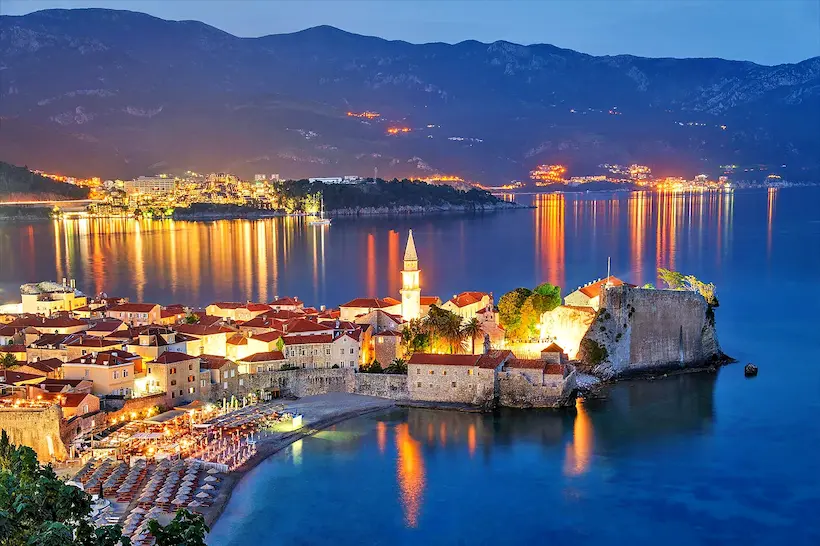
Different sides of Budva
- Historic center
- Stone houses within the walls
- Resort architecture
- Slovenska Plaza’s low buildings
- Residential areas
- Rozino and Dubovica
Get to know Budva through its neighborhoods
Beyond the Old Town, Budva was not built to a single design. Planned housing estates sit alongside areas that expanded through extensions to houses and the construction of apartments. The name Slovenska Plaza refers both to the town beach and to the resort beside it.
01Old Town
Stone houses stand close together, and narrow streets open at intervals into small squares. Along Njegoseva, the Old Town’s main street, most houses share their side walls. Shutters, stone door frames and balconies stand out on the stone facades.
The lower floors once housed craft workshops and small shops, while the upper floors were homes. Some houses also had internal courtyards behind the buildings lining the street. Today, the ground floors contain shops and restaurants.
Trg pjesnika, a small square off Njegoseva, hosts literary evenings during the Grad Teatar festival. Grad Teatar is Budva’s theater and arts festival, and the square’s name, meaning Poets’ Square, is linked to its literary evenings. The history of the walls and individual monuments is covered in the guide to Budva’s sights.
02Slovenska Plaza
A promenade runs along Slovenska Plaza beach. Behind the shore is the resort of the same name, made up of low white buildings, courtyards and pedestrian passages. Sloping roofs and stone window and door frames give it a different appearance from large hotel buildings or multistory apartment blocks.
Architect Janez Kobe designed the resort with the traditional villages of Budva’s hinterland as his model. Small groups of houses, squares and passages provided the starting point for a modern resort.
The resort’s main pedestrian street is called Korzo. Smaller passages branch off toward the accommodation buildings and internal courtyards. Around Trg cempresa, or Cypress Square, the buildings form courtyard spaces with covered passages and rows of arches.
03Rozino
Rozino is a residential part of Budva where family houses, apartment buildings and public institutions stand alongside one another. It has no single, consistent appearance like the Old Town or Slovenska Plaza resort. Shops and other business premises occupy the ground floors of residential buildings along the busier streets.
The area around Mainski put road developed through construction on separate plots. Houses were extended outward and upward, giving the area buildings of different heights and shapes. Mainski put connects these residential streets with central Budva. The layout varies across Rozino: some larger buildings have shared paved or green spaces, while elsewhere houses and apartment blocks stand much closer together.
Akademija znanja, the Academy of Knowledge, hosts lectures, workshops and cultural programs, and the building also has a reading space. The open area in front of the Academy is also used for children’s play and gatherings. For more on shopping, socializing and other daily habits, read Everyday life in Budva.
04Dubovica
Dubovica has connected rows of lower residential buildings, larger apartment blocks and houses on the hillside. The hill shapes the area: rather than occupying a single level site, the buildings and their approaches follow the terrain.
One of its planned housing estates is Pod Dubovicom. Architects Dimitrije Ivancevic and Vladimir Macura designed a connected group of residential buildings with open spaces between them. Its lower rows with sloping roofs form a recognizable architectural group. Green spaces were laid out between the buildings, with separate areas for sport.
Dubovica Lux has a different layout, with taller residential buildings following the slope. It has landscaped green spaces, while natural vegetation grows along its northwestern edge.
Later extensions to buildings in Pod Dubovicom and nearby family houses increased residential density. This growth also increased demand for parking.
Would you like to explore more of Budva?
Continue exploring Budva through local stories and guides to the city and its surroundings.
For the rest of your stay, choose a guide to arrival, accommodations, food, attractions or trips from Budva.
Guides to nearby towns
Petrovac
Open the city guide
Cetinje
Open the city guide
Kotor
Open the city guide
Tivat
Open the city guide
Bar
Open the city guide
Herceg Novi
Open the city guide
Igalo
Open the city guide
Podgorica
Open the city guide
Ulcinj
Open the city guide
Zabljak
Open the city guideCity stories from other towns
Connect your stay in Budva with other coastal towns, mountains, airports and practical information for the rest of the country.
