01Budva’s location and climate
The town lies between the bay and the hills, with warm summers, rainy winters and different coastal winds.
Budva’s location and climate
The town lies between the bay and the hills, with warm summers, rainy winters and different coastal winds.
Budva between the sea and the hills
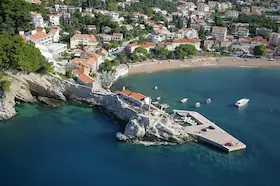
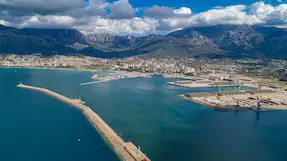
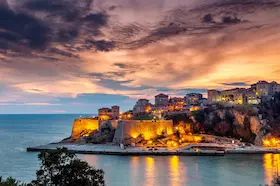
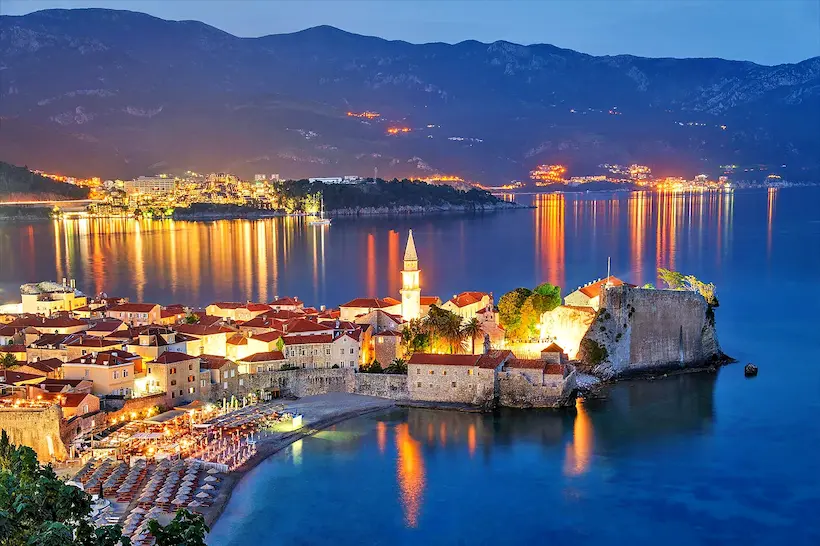
Budva lies on the central stretch of Montenegro’s coast. Behind the waterfront is Budvansko polje, an area of flatter ground across which the newer town has expanded toward the hills. Steeper terrain encloses it on the landward side, while Budva Bay opens toward the sea. The Old Town stands on a small peninsula beside the harbor, at the western end of the town’s waterfront.
Slovenska Beach and the promenade run east from the harbor to Cape Zavala. The Becici coast begins on the other side of the cape. Becici is a separate settlement, so crossing Zavala also takes you beyond the town of Budva itself. Sveti Nikola island lies opposite the town, in the bay.
The Budva Riviera covers a much longer coastline than the town alone, from Jaz in the west to Buljarica in the southeast. It also includes Becici, Rafailovici, Przno, Sveti Stefan and Petrovac. The name Budva is therefore often used for a stay anywhere along the riviera, but these places are separate settlements rather than neighborhoods of Budva.
Summer and winter on Budva’s coast
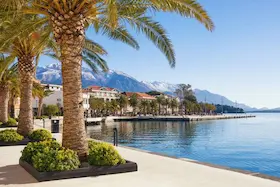
Budva’s coast has a Mediterranean climate, with long, warm and mostly dry summers and milder, wetter winters. The open promenade is exposed to both sun and wind, unlike the narrower streets between the stone houses.
Bura is a wind from the inland hills that brings colder air. Jugo blows in from the sea and is often associated with cloudy, rainy weather. In summer, the maestral wind blows in from the sea and eases the daytime heat. Rain and strong winds can therefore affect a winter stay on the coast, even though temperatures are milder than in the mountainous interior.
02Budva’s history and development
Ancient finds, Venetian additions and rebuilding after the earthquake belong to different periods of Budva’s history.
Budva’s history and development
Ancient finds, Venetian additions and rebuilding after the earthquake belong to different periods of Budva’s history.
Ancient Budva, earlier names and the legend of Cadmus
Budva was a settlement in antiquity. Written references and archaeological finds describe a town much older than its present walls. Its necropolis, the burial ground for the inhabitants, lay west of the main town gate and extended toward the slopes of Spas hill. Objects from its Greek and Roman graves are now kept in the Budva Town Museum.
The ancient settlement also had streets within the area of today’s Old Town. When the museum building was restored after the earthquake, part of a Roman street paved with large stone slabs was discovered.
Old records contain several forms of the town’s name, including Butua and Buthos. Budva is also associated with the legend of Cadmus and Harmonia, whom tradition credits with founding the town. The legend describes a mythical origin. Archaeological finds from the settlement and burial ground document Budva’s ancient past.
The medieval town and Venetian fortifications
In the Middle Ages, Budva was a fortified town with its own statute, a document regulating town life and relations between its inhabitants. It was drawn up in the fourteenth century, during the reign of Emperor Dusan. The town was governed by a knez (town governor), appointed by the ruler and usually a foreigner. The original statute has not survived, so its contents are known from later copies.
The walls owe much of their present appearance to Venetian rule. From the fifteenth to the eighteenth century, the fortifications were extended and adapted for defense. A relief of the winged lion of Saint Mark remains a visible symbol of Venice. Older sections of the walls also survive, alongside later alterations and repairs following earthquakes.
Tourism growth and rebuilding after the earthquake
Tourism expanded Budva far beyond its walls during the twentieth century. Hotel Avala opened in 1939, when modern seaside tourism was developing. Later hotel and apartment construction along Slovenska Beach and in Budvansko polje created a larger town around the old center.
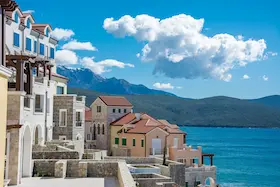
The earthquake of 1979 severely damaged the Old Town. Restoration over the following years brought houses, streets and fortifications back into use and included work on historic buildings. Today’s stone facades therefore also reflect extensive rebuilding in the late twentieth century. While the existing town was being restored inside the walls, hotels, apartments and associated town facilities continued to be built outside them.
03The Old Town and modern Budva
Inside the walls are narrow stone streets, while along Slovenska Beach and behind it are the newer town’s hotels and residential areas.
The Old Town and modern Budva
Inside the walls are narrow stone streets, while along Slovenska Beach and behind it are the newer town’s hotels and residential areas.
Streets and squares inside the walls
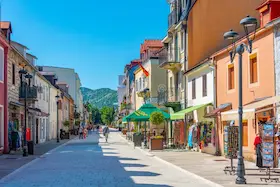
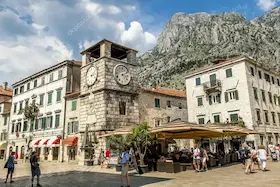
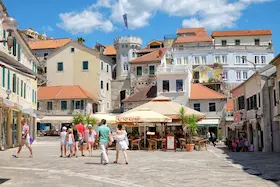
Budva’s Old Town occupies a peninsula. Its walls follow the seaward edge and enclose the approach from land. Within them, houses stand close together, streets are narrow and squares are small. There are no long boulevards. Streets open into small squares, passages and exits toward the shore.
These streets now contain shops and restaurants, galleries and museum spaces. Pedestrian passages connect their entrances with small squares and exits toward the sea.
The town around Slovenska Beach and Budvansko polje
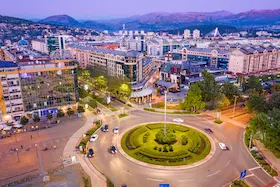
Outside the walls, Budva is built on a different scale. A promenade and hotel area run along Slovenska Beach, while residential streets spread inland across Budvansko polje. Hotel complexes and larger apartment buildings occupy far more space than the stone houses within the walls. The difference is visible from both the waterfront and a panoramic view of the town.
Tourism development is part of this expansion, but residential streets and municipal services also lie behind the coastal hotels. The waterfront promenade, hotel complexes and streets behind them serve different purposes. Much of the visitor accommodation and other tourism facilities is concentrated beside the sea. Further inland are homes and services needed throughout the year.
04Culture in Budva
The museum holds archaeological and ethnographic collections, the gallery presents modern art, and the summer Grad teatar festival also uses outdoor stages.
Culture in Budva
The museum holds archaeological and ethnographic collections, the gallery presents modern art, and the summer Grad teatar festival also uses outdoor stages.
Museum collections, Ljubisa and Grad teatar
The Budva Town Museum holds archaeological and ethnographic collections. The archaeological collection relates to the ancient settlement and finds from the burial ground, while the ethnographic collection presents the later life and customs of the area. Fishing tackle and navigational instruments recall life beside the sea. The archaeological collection includes Greek clay vessels and gold jewelry, as well as Roman stone urns.
Contemporary visual art is represented at the Jovo Ivanovic Modern Gallery. The Stefan Mitrov Ljubisa Memorial House preserves Budva’s literary heritage and is dedicated to the writer and public figure born in the town. Their current exhibitions and notices show what is available at the time of your visit.
Grad teatar began in 1987. The summer festival includes theater, music, literature and visual arts, with some of its stages in outdoor town spaces. Plays and literary events thus take place on the town’s squares. Dates and venues are published in the official Grad teatar program for that summer’s edition.
05A brief overview of Budva’s attractions
The Old Town, Mogren and Sveti Nikola island offer different ways to continue a visit in the town and its bay.
A brief overview of Budva’s attractions
The Old Town, Mogren and Sveti Nikola island offer different ways to continue a visit in the town and its bay.
From the town walls to the coast
Continue through the Old Town for historic buildings and museum spaces. Mogren, to its west, has a different coastline, with beaches beside the rocks. Sveti Nikola island lies opposite the town and requires a separate trip out to sea. The guide to Budva’s attractions covers these places in detail and distinguishes the wider riviera from a visit within the town.
When choosing a meal, Budva’s restaurant recommendations point you to individual places to eat. For an overnight stay, the accommodation guide compares areas of the town and neighboring coast.
The Old Town, Slovenska Beach and Becici
At the western end of the town’s waterfront, immediately beside the harbor.
The town beach and promenade extend east of the Old Town.
The Becici coast begins on the eastern side of the cape, beyond the town of Budva itself.