01Herceg Novi's location, climate and greenery
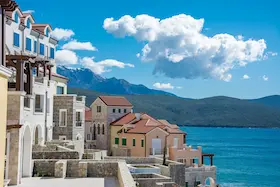
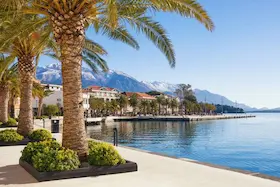
Orjen rises inland, while parks and gardens spread across the coastal slope.
Herceg Novi's location, climate and greenery
Orjen rises inland, while parks and gardens spread across the coastal slope.
At the entrance to the Bay of Kotor below Orjen
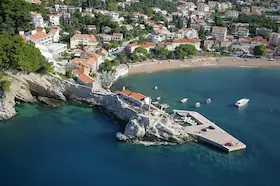
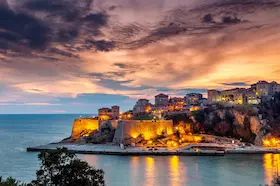
Herceg Novi stands beside the entrance to the Bay of Kotor, where the bay opens onto the Adriatic. Orjen rises behind the coastal strip, and the town spreads across the slope between the sea and the mountainous hinterland. This position mattered to the fortified town, whose elevated defenses overlooked the approaches from both the sea and inland.
The terrain also shaped today's street layout. The old center occupies several levels, with the town harbor at the bottom and fortifications above it. Beyond the center, the town expanded along the coast toward neighboring settlements, but their streets also climb away from the sea. A neighborhood's coastal location therefore does not mean that all of it lies at the same elevation.
Mediterranean climate, parks and gardens
The coast around Herceg Novi has a Mediterranean climate, with long, warm summers and mild winters. Mountain ranges inland shelter the riviera from cold northerly winds. These conditions favor coastal vegetation, but the appearance of today's gardens also owes much to plants that seafarers brought home from their voyages. Palms, mimosas, magnolias and agaves grow alongside native plants.
The gardens adapt to the steep terrain. Boka Park is arranged on terraces rather than a single level surface. In Topla, the City Museum's garden extends from the museum house toward the sea. Greenery is therefore found beyond dedicated parks, around houses and buildings left to the town, between the built-up parts of the slope.
02The town's founding, name and changes of rule
Tvrtko's founding of the town, the name associated with Kosaca and additions to the fortresses under successive rulers.
The town's founding, name and changes of rule
Tvrtko's founding of the town, the name associated with Kosaca and additions to the fortresses under successive rulers.
Tvrtko's founding of the town and the name Herceg Novi
The Bosnian king Tvrtko I Kotromanic founded the fortified town in 1382. He wanted to develop a center for trade, shipping and crafts on this stretch of coast and give Bosnia its own access to the sea, with less dependence on Dubrovnik's port. The town was named Sveti Stjepan, or Saint Stephen, but the shorter name Novi came into common use.
The present name Herceg Novi is associated with Duke Stjepan Vukcic Kosaca, a later medieval ruler of the town. Arms making, goldsmithing, blacksmithing and shoemaking developed during his rule. The town thus bears a name associated with Kosaca, although Tvrtko founded it. Some of the surviving objects from these crafts are preserved in the treasury of Savina Monastery.
Changes of rule and fortifications above the sea
After its medieval rulers, Herceg Novi spent a long period under Ottoman rule, interrupted by a brief Spanish takeover. The Venetians captured the town in 1687 and repaired its damaged walls. Administrations changed again after the fall of the Venetian Republic, and the Austrian authorities also altered the fortresses. Their present appearance is therefore the result of more than one period or builder.
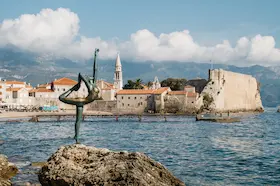
Forte Mare stands on the southern side of the Old Town, above the approach from the sea. Its construction includes medieval beginnings, Ottoman extensions and later Venetian and Austrian work. Kanli Kula stands at the northern edge of the old center. During the Ottoman period it also served as a prison. The two fortresses guarded different approaches to the same town.
Spanjola was built on a higher hill above the old center. Its name recalls the brief Spanish presence, but its present form includes later Ottoman construction and other alterations.
03The old center and coastal areas
From the squares above Skver to Topla, Igalo, Savina and Meljine along the coast.
The old center and coastal areas
From the squares above Skver to Topla, Igalo, Savina and Meljine along the coast.
Squares, stairways and Skver harbor
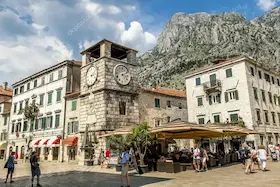
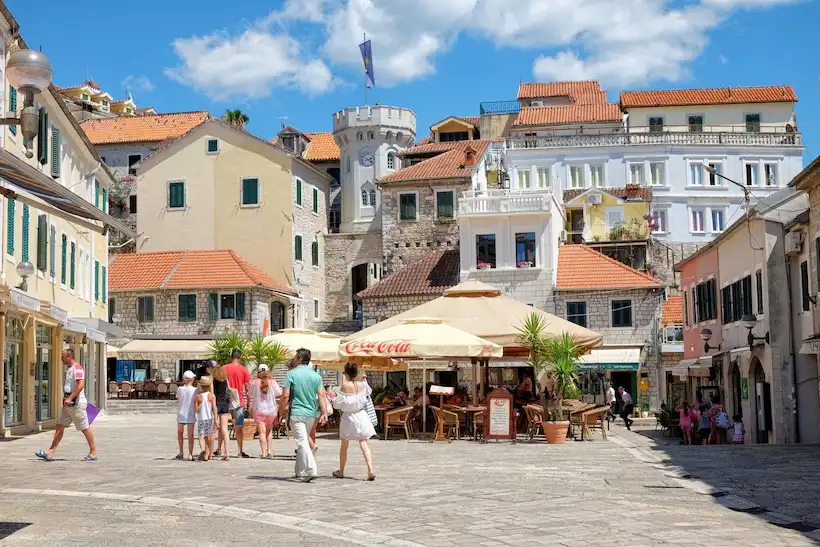
Nikola Durkovic Square lies below the Clock Tower. The King Tvrtko stairway passes through the gateway beneath the tower and leads to the higher Herceg Stjepan Square, known as Belavista, with the Church of St Michael the Archangel. The tower thus stands between two squares at different levels, directly connected by the steps.
From Belavista, Marko Vojinovic Street leads down steps toward the area beside Forte Mare. Other town stairways descend to the Pet Danica promenade and Skver, the town harbor on the waterfront. Exploring the Old Town therefore involves more than moving from street to street. Within a small area, you also move between levels, from the upper squares toward the sea.
The coast from Igalo and Topla to Savina and Meljine
Topla lies west of the Old Town, with Igalo farther along the coast. Savina is to the east, followed by Meljine. The Pet Danica promenade follows the coast from Igalo to Meljine and passes below the historic center. It connects the inhabited coastal strip, while streets branch off inland and climb the slope.
Igalo is known for the healthcare and rehabilitation tradition of the Dr Simo Milosevic Institute. The institute specializes in physical medicine, rehabilitation and rheumatology, giving this part of the coast a role as a healthcare center. This differs from the development of the fortified old center, whose origins were shaped by trade and defense.
On the eastern side, Savinska Dubrava forms a green belt between Herceg Novi and Meljine. It contains Savina Monastery, with its churches, residential building, treasury and library. The wooded slope and monastery complex give Savina a distinctive appearance within the inhabited coastal area.
04Culture in Herceg Novi
Local heritage collections and contemporary art, Andric's house and programs in halls and fortresses.
Culture in Herceg Novi
Local heritage collections and contemporary art, Andric's house and programs in halls and fortresses.
Museum collections, literary heritage and cultural venues
The Mirko Komnenovic City Museum in Topla occupies a house bequeathed to the town. Its archaeological, historical, art and ethnological collections cover the past of the surrounding area. Objects from urban and rural households reveal ways of life, while those brought home by seafarers reflect Herceg Novi's connections with other parts of the world.
The Josip Bepo Benkovic Gallery is devoted to contemporary visual art. It is associated with the Herceg Novi Winter Salon, which features artists from Montenegro and the region. The museum and gallery belong to the same municipal public institution but serve different interests. The local heritage collections present the area's past, while the gallery focuses on contemporary art.
The House of Nobel Laureate Ivo Andric preserves the memory of the writer and his wife Milica Babic, who lived in Herceg Novi. As well as serving as a memorial, the house hosts literary programs. The public cultural institution Herceg Fest also organizes theater, film and music programs. Dvorana Park is its indoor venue.
Forte Mare and Kanli Kula also serve as outdoor cultural venues, including during the Herceg Novi Film Festival. The winter Mimosa Festival brings carnival parades, masked balls and concerts.
05A brief overview of Herceg Novi's sights
Continue to individual places, restaurants and the choice of an area to stay in.
A brief overview of Herceg Novi's sights
Continue to individual places, restaurants and the choice of an area to stay in.
A brief overview of Herceg Novi's sights
Forte Mare and Kanli Kula represent the fortified town at different elevations. Belavista and the Clock Tower connect the squares and gateway of the old center, while Savina Monastery and the City Museum in Topla extend the overview toward its eastern and western areas. The guide to Herceg Novi's sights covers individual places and how to visit them.
For choosing a meal, the restaurant recommendations for Herceg Novi lead to specific places to eat. The accommodation guide helps relate your choice of stay to its position on or above the coast.
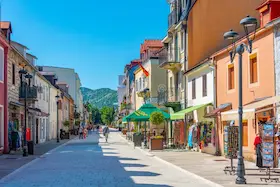
The old center and the coast to the west and east
The Clock Tower and Belavista on the slope, with stairways down to the town harbor and promenade.
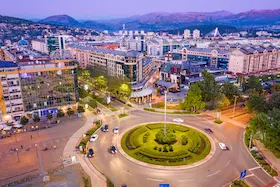
The town's westward extension, linked by the promenade to the coast below the old center.
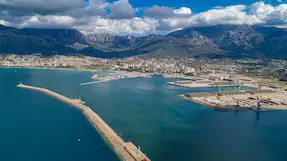
The inhabited coast toward Meljine, beside Savina's green belt and monastery complex.