
Podgorica in 1 day: Stara Varos, Moraca and Gorica Hill
The Clock Tower rises above Stara Varos as one of Podgorica’s few surviving Ottoman monuments. Around it, you can walk along lanes between houses, gates and courtyards in the former city center, where people still live today. For a one-day visit, the appeal is how close this old neighborhood is to the river confluence: after exploring its streets, you can head down to the water and spend the afternoon in the woodland of Gorica Hill above the city center.
Walk overview
- Walking and sightseeing time
- 6 hours
- Number of stages
- 6
- Route length
- about 4.6 km
Why choose this walk?
This walk combines the old town, the riverbanks and Gorica Hill, with lunch in the city center. It suits visitors who want to spend most of the day outdoors, without visiting museums or traveling outside the city.
There are uneven steps at Sastavci and an uphill walk to the memorial on Gorica. The route is unsuitable for strollers or people with limited mobility. In July and August, expect high temperatures and stretches of the walk without shade.
Itinerary details
| Itinerary | Practical details |
|---|---|
| Duration | 6 hours |
| Getting around | On foot, about 4.6 km in total. |
| Sights on the itinerary | |
| Start and finish | Clock Tower → Independence Square. |

Walking itinerary and breaks
01The Clock Tower and the lanes of Stara Varos
Morning45-60 minutes
Start at Becir-beg Osmanagic Square and view the Clock Tower from the outside. After the square, walk along the surrounding lanes, where the houses are lower and the streets narrower than in the newer city center. It is worth allowing time to explore between the houses, rather than stopping only briefly in front of the tower.
From Stara Varos, continue toward the Ribnica via Kese Djurovica and Spasa Nikolica streets. This walk and the descent to the confluence are included in the next stage.
02Sastavci and the old bridge over the Ribnica
Later in the morning30-45 minutes
The approach to Sastavci is about 600 meters from the Clock Tower, or a 10-15 minute walk through Stara Varos. Head down to the stone bridge over the Ribnica and allow another 20-30 minutes for the bridge and confluence: the Ribnica flows beneath a single stone arch, while the Moraca runs through its wider riverbed in front of it.
The approach has uneven steps and is unsuitable for strollers or people with limited mobility. At high water, it is unsafe to go down to the confluence. After your visit, return to street level and continue toward the city center for lunch.
03A local lunch and a break in the city center
Lunch and a rest10-15 minutes walking
From Sastavci, climb back to street level and follow Njegoseva toward the city center. Bokeska Street is about 550 meters away, a 10-15 minute walk included in the six hours of sightseeing. Allow an additional 90-120 minutes for lunch and a rest. Podgorica’s popeci, fried pork rolls, are one local option for a meal.
Finish your break on Bokeska or neighboring Njegoseva Street, close to Njegosev Park. For somewhere to eat, see restaurants and cafes in Podgorica.
04Njegosev Park, the Moraca and a view of Millennium Bridge
Afternoon by the Moraca40-50 minutes
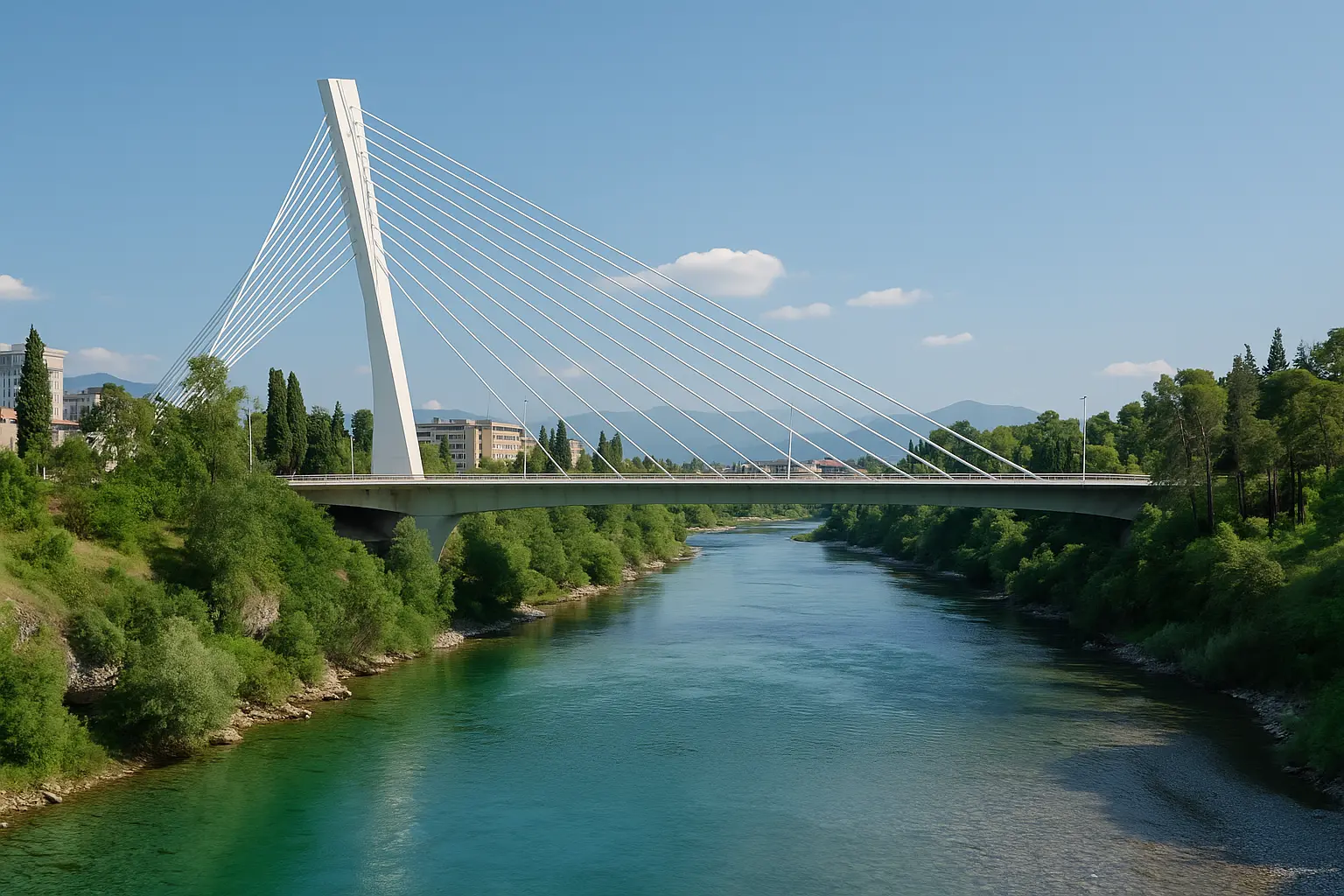
From Bokeska Street, Njegosev Park is about 450 meters away, a walk of roughly 5-10 minutes. Pass the monument to Petar II Petrovic Njegos, then follow the riverbank to the pedestrian Moscow Bridge. From there, you see Millennium Bridge from the side, with its tall pylon and cables above the Moraca.
The walk from the park to Moscow Bridge is another 350 meters. This stage includes walking, visiting the monument and time on the bridge. A short rest in the park takes additional time. Then return to the bank where Njegosev Park and the city center are located. The onward route to Gorica follows city streets past the stadium. The lower path beside the water does not form a continuous connection to the hill.
05The Church of St. George and Gorica Hill to the memorial
Afternoon on Gorica Hill75-110 minutes
From Moscow Bridge, the Church of St. George at the main entrance to Gorica Hill is about 900 meters away, a 15-20 minute walk along city streets. Approach the church and the old cemetery, then follow the maintained path uphill to the Partisan Fighter Monument. You can enter the church if it is open. The exterior visit and walk to the memorial do not depend on this.
The climb from the church to the memorial is about 550 meters. Look at the mausoleum and the sculptures of fighters, take a break and return to the church along the same path. This stage includes the approach from the Moraca, the visit by the church, the climb, viewing the memorial and the descent. A rest at the memorial takes additional time.
06Return to Independence Square and an evening in the city center
Return to the city center15-25 minutes
From the Church of St. George, return past the stadium to Slobode Street and continue toward Independence Square. This return walk is about 700 meters, ending the day near cafes and restaurants without going back to the bridges.
For dinner or a drink, stay on Bokeska or neighboring Njegoseva Street. Several venues are grouped close together. After the walk, choose a place for the evening in the city center. Time for lunch, rest, dinner or drinks is not included in the six hours of sightseeing.
Sights on the itinerary
01The Clock Tower and Stara Varos, surviving traces of Ottoman Podgorica
Stara Varos was Podgorica’s city center under Ottoman rule. The Clock Tower remained among the few surviving Ottoman buildings after the widespread destruction of Podgorica during World War II. Residential streets, gates and courtyards surround it, offering a glimpse of the former city through what remains.
The Clock Tower provided a public time reference when personal watches were uncommon. Its clock face points west, toward the Ribnica and Moraca rivers and the area where Stara Varos developed. This is why the clock is not equally visible from every side of the square: its position reflects the layout of the city at the time.
Look at the small openings in the stone walls and the tower’s height above the surrounding houses. The clock mechanism and bell are inside and are not part of this exterior visit.
Stone and plastered walls, gates and courtyard entrances line the neighboring lanes. People still live here. Older buildings remain alongside later alterations, with different parts preserved to different degrees, rather than the uniform appearance of a restored museum complex.
02Sastavci, two rivers and a small stone bridge
Sastavci is where the Ribnica flows into the Moraca. The small stone bridge crosses the narrower Ribnica just before it meets the much wider Moraca. From the upper bank, you can see both rivers and their confluence. Walking down brings you closer to the bridge and the water.
The bridge has a single stone arch and a low approach. Notice how the arch rises over the smaller riverbed, with the open space of the Moraca behind it. The steps and rocky surfaces make this confluence look quite different from the landscaped riverside walks in the newer city center.
Water levels change both the view and access. After rain, the lower areas may be submerged. At low water, more rock is exposed around the confluence. Swimming and crossing the rocks are not part of this itinerary.
The name Skaline is used for the area around the confluence, and city descriptions also call the crossing the bridge at Sastavci. These names refer to the same place and bridge you are visiting, rather than additional stops.
03The Moraca River, the park, Moscow Bridge and Millennium Bridge
The Moraca runs through a broad riverbed below Podgorica’s streets. In Njegosev Park, you approach it through the trees, with views over the riverbed. The monument to Petar II Petrovic Njegos stands among the park’s trees, near the path toward the bridges.
Moscow Bridge is for pedestrians. From it, you see the modern Millennium Bridge from the side, with a clear view of the tall pylon and the cables supporting the structure. Millennium Bridge opened in 2005 and was designed by engineer Mladen Ulicevic. From the neighboring bridge, you can see its structure and the Moraca flowing below it at the same time.
Njegosev Park also has the Dragan Ivanovic basketball court, where generations of Buducnost players developed their skills.
04Gorica Hill, the old church, woodland and memorial
The Church of St. George stands at the main entrance to Gorica Hill, beside the old city cemetery. Its oldest parts date to the Middle Ages, but it has been altered and extended several times. The small building you see today retains elements from several periods. Its position beside the cemetery and hill reveals an older part of the city, close to today’s busy streets.
Inside are frescoes by an anonymous painter and an iconostasis.
Gorica is a wooded park with maintained walking paths. The path from the church to the Partisan Fighter Monument climbs uphill, making this part of the itinerary more demanding than the walk through the city center and Njegosev Park.
The memorial is a mausoleum dedicated to World War II fighters from Montenegro. Architect Vojislav Djokic designed it, and sculptor Drago Djurovic created the statues. Two large figures of fighters stand in front of the entrance. The white stone and broad approach give the monument a much larger scale than the church at the foot of the hill. National heroes and revolutionaries are buried in the mausoleum. This itinerary visits the exterior and does not depend on access to the crypt.
The monument was unveiled on July 13, 1957, on the anniversary of the antifascist uprising in Montenegro. Above the entrance are the dates 1941 and 1945 and an image of the Order of the People’s Hero. Together with the figures of fighters, these details explain whom the memorial honors and why Gorica preserves an important place of wartime remembrance alongside its woodland walks.
Questions about spending 1 day in Podgorica
Is eight hours between flights enough for the full itinerary?
It is not enough for this full program: allow six hours for walking and visits, with lunch and breaks extending your time in the city. Podgorica Airport recommends arriving at least two hours before your flight, while also following your airline’s requirements. You also need time to leave the airport after landing and travel to and from the city, so eight hours between flights does not mean eight hours available in Podgorica.
Can I explore the city and take a Lake Skadar boat trip on the same day?
Allow separate days for the full city walk and a boat trip from Virpazar. The lake outing includes traveling from Podgorica, reaching the departure point, taking the boat and returning, so combining it with this itinerary would leave much less time to explore the city.
Is this walking itinerary a good choice in July and August?
Podgorica has many summer days above 30 °C, so this walk calls for more caution than in milder parts of the year. Most of the day is outdoors, and the final walk to the memorial on Gorica includes a climb. Parks provide shade in places, but the entire route is not shaded. Before deciding on an all-day walk, check the forecast for Podgorica and any heat warnings. During a heat wave, do not assume that being near the rivers will make the high temperatures easier to bear.
More Podgorica itineraries
Guides to other places in Montenegro
Cetinje
Open guide
Petrovac
Open guide
Budva
Open guide
Kotor
Open guide
Bar
Open guide
Tivat
Open guide
Ulcinj
Open guide
Herceg Novi
Open guide
Igalo
Open guide
Zabljak
Open guideItineraries for nearby destinations
For the next part of your trip, explore the coast, Lake Skadar, mountain destinations, airports and practical information for driving in Montenegro.
