
Bar neighbourhoods: Makedonsko Naselje and Stari Bar's bazaar
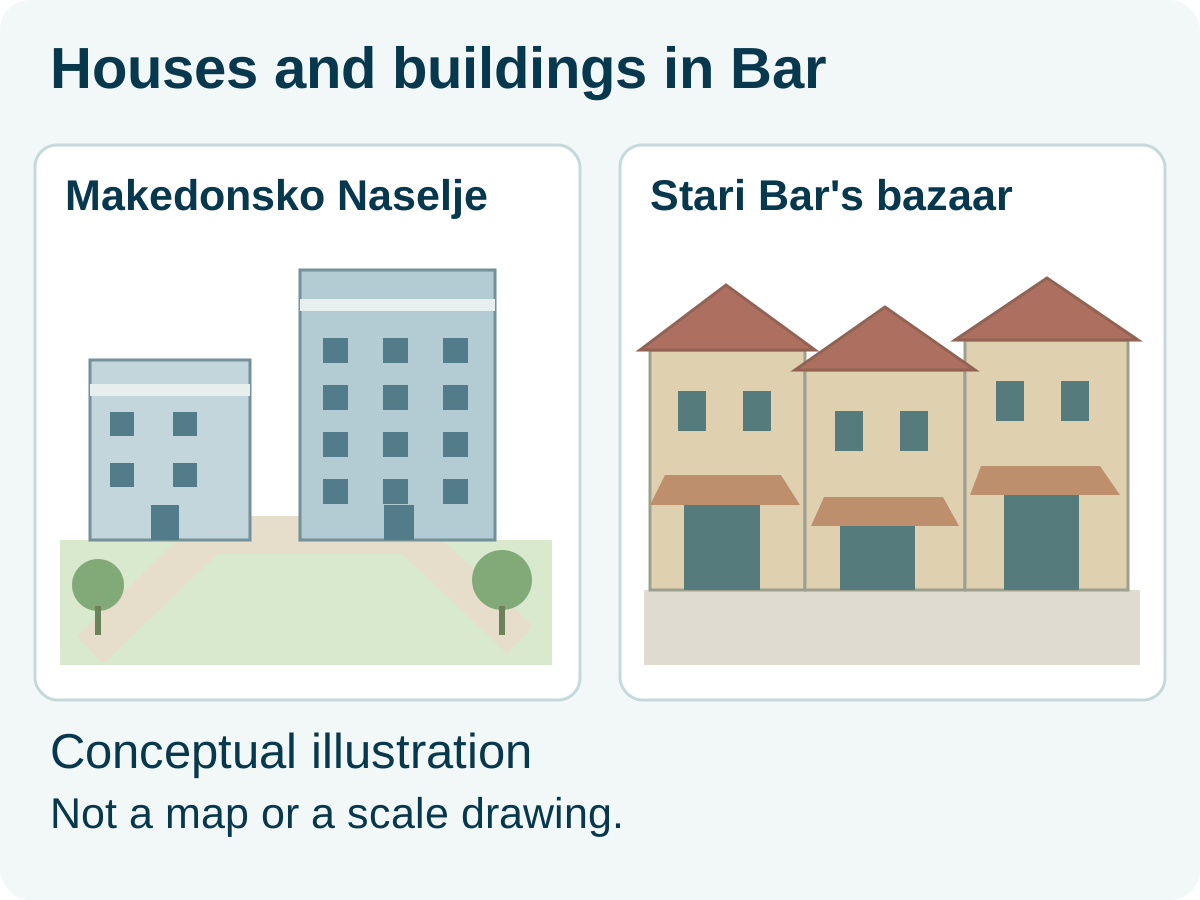
Green spaces and footpaths lie between blocks of flats in Makedonsko Naselje. Stari Bar's bazaar has a different layout: houses stand side by side, with shops and other businesses opening onto the same narrow street.
Housing and local names
- Makedonska Street
- Named to thank the builders
- Multi-storey bazaar houses
- Historically: shop below, home above
Two approaches to building homes
Entire new blocks of flats were built in Bar during reconstruction after an earthquake. Stari Bar's bazaar developed beside the fortified town as the settlement's trading and craft quarter.
01Makedonsko Naselje
Macedonian builders constructed the original housing complex after a devastating earthquake left many families in Bar without homes. The decision was to build permanent flats rather than temporary prefabricated housing.
The building designs were adapted from the Aerodrom neighbourhood in Skopje. The blocks of flats had a ground floor, two or four upper floors, and an attic.
Makedonska Street was named to thank the builders for their work. The neighbourhood also gained Jugoslavija Primary School, built with solidarity funds from the Yugoslav republics of the time.
Today, the name Makedonsko is also used for a wider area than the original housing complex. This wider area includes Borska Street, whose pavements and side paths lead to residential entrances, with parking and trees between the buildings. During the street's reconstruction, benches were installed, and some planned new paths were left unbuilt to preserve existing trees.
Our article on everyday life in Bar covers shopping, coffee and other local routines.
02Stari Bar's bazaar
Stari Bar's bazaar is a row of houses and shops outside the old town walls, in the settlement below them. The main street climbs and curves between houses that face onto it.
The bazaar developed under Ottoman rule as the settlement's trading and craft quarter. In multi-storey houses, the ground floor was intended for a shop or workshop, with living space upstairs. Because of the steep terrain, the street once had stepped cobblestone paving, later replaced by stone slabs.
Today, shops, restaurants and cafes line the street, with awnings and tables along the building fronts. Stone facades, broad eaves and wooden window shutters are visible along the street.
Our guide to Bar's attractions covers the walls and buildings inside the old town in more detail.
Want more stories about Bar?
Discover more about Bar through local stories and guides to the city and its surroundings.
Continue your stay with a guide to getting here, places to stay, food, attractions, or trips from Bar.
Guides to other towns and cities
Petrovac
Open the city guide
Ulcinj
Open the city guide
Budva
Open the city guide
Cetinje
Open the city guide
Podgorica
Open the city guide
Kotor
Open the city guide
Tivat
Open the city guide
Herceg Novi
Open the city guide
Igalo
Open the city guide
Zabljak
Open the city guideLocal stories from other towns and cities
Connect your stay in Bar with the coast, mountains, airports, and practical information for the rest of the country.
