
01The city, mountains and lake district
Bar's coastal location and its relationship with the wider municipality.
The city, mountains and lake district
Bar's coastal location and its relationship with the wider municipality.
Between the Adriatic and Lake Skadar
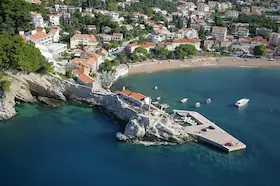
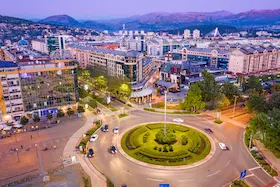
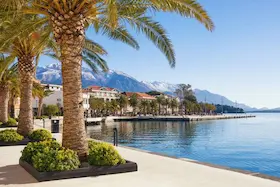
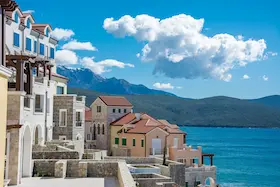
Bar lies on the south-eastern stretch of Montenegro's coast. The municipality of Bar includes the coastal strip, mountains and the shore of Lake Skadar. Virpazar is a separate settlement in its lakeside area. A belt of mountains lies between the city by the sea and the lake district.
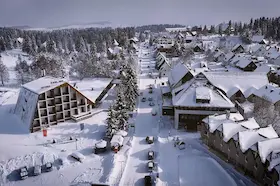
Bar itself has a Mediterranean climate, with long, dry summers and mild, rainy winters. The municipality's higher areas have a mountain climate, while the area around Lake Skadar has a stronger continental influence and greater changes in temperature.
02From Stari Bar to a port city
The fortified town's historical layers, the relocation of its residents and the development of the harbour.
From Stari Bar to a port city
The fortified town's historical layers, the relocation of its residents and the development of the harbour.
Stari Bar and the move to the coast
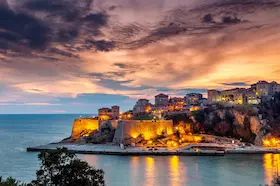
The old town of Bar was built on a rise at the foot of Mount Rumija. Its walls and the remains of churches, palaces and olive mills preserve traces of different eras, while the Ottoman-era aqueduct shows how water was brought to the fortified town.
War damage in the 19th century left the town unsuitable for continued settlement. Residents first moved to Podgradje, a settlement outside the walls. The city later expanded around Pristan, the harbour in what is now Novi Bar (New Bar).
The port and the growth of Novi Bar
The coastal city's development was linked to the construction of its harbour. In 1906, a contract for the construction and operation of the harbour in Bar was signed in Cetinje. It also included planned connections towards Lake Skadar.
Today's port complex consists of breakwaters, piers, working quays and cargo terminals. Cargo handling and storage, together with connections to inland transport, give Bar an economic role reflected in the appearance of its waterfront.
03The connection inland
The railway and the meeting of maritime and land transport.
The connection inland
The railway and the meeting of maritime and land transport.
The railway connection inland
The first regular passenger train left Belgrade for Bar in 1976. The railway connected the coastal city to the interior, while the combination of railway and port infrastructure strengthened its role as a meeting point for maritime and land transport.
04Royal, olive-growing and cultural heritage
The palace and museum, Stara Maslina and the House of Olives, cultural institutions and the festival.
Royal, olive-growing and cultural heritage
The palace and museum, Stara Maslina and the House of Olives, cultural institutions and the festival.
King Nikola's Palace and the local history museum
King Nikola's Palace at Topolica is part of the former royal complex by the sea. Its 19th-century residential architecture and surrounding park preserve the character of a place designed for the royal family's stays.
The former residence now houses the Bar Local History Museum. The museum holds archaeological finds, historical material, objects from everyday life in the Bar region and works of art.
Bar's olive-growing heritage
Stara Maslina (Old Olive Tree) grows at Mirovica and is protected as a natural monument. It belongs to the Zutica olive variety, which is cultivated on Montenegro's coast.
The House of Olives (Kuca Maslina) in Stari Bar connects this tradition with present-day production. Alongside caring for Stara Maslina, it provides services for processing olives and packaging olive oil, expert support for producers and space to showcase local products.
Cultural institutions and Barski Ljetopis
The Vladimir Popovic Spanac House of Culture hosts theatre, music and film programmes. The Velimir A. Lekovic Gallery on the waterfront presents contemporary art through solo and group exhibitions.
Barski Ljetopis brings together theatre, literature, music and visual art. The festival uses the House of Culture's hall, a summer stage and a stage in the old town, so its programme takes place both by the coast and in the historic town beneath Rumija.
05A brief overview of places in Bar
Historic and natural landmarks, with guides to food and accommodation.
A brief overview of places in Bar
Historic and natural landmarks, with guides to food and accommodation.
A brief overview of places in Bar
The palace at Topolica, the walls of Stari Bar and Stara Maslina at Mirovica represent royal, urban and olive-growing heritage in different locations. Individual sites and their distinctive features are covered in more detail among Bar's attractions.
Staying by the coast and staying near Stari Bar place visitors in different parts of the city. Guides to where to eat in Bar and where to stay in Bar help with choosing specific places in the part of Bar where you want to spend time.
The coast, Stari Bar and Mirovica
Port areas and the marina by the sea, with the palace park and local history museum at Topolica.
The fortified historic town, with walls, building remains and an Ottoman-era aqueduct.
The site of Stara Maslina, a protected tree of the Zutica variety.