01Location and climate
Cetinjsko Polje, Lovcen and the relationship between rainfall and karst terrain.
Location and climate
Cetinjsko Polje, Lovcen and the relationship between rainfall and karst terrain.
Cetinjsko Polje below Lovcen
Cetinje lies in southern Montenegro, in an enclosed karst basin below Lovcen. The city stands at around 670 metres above sea level. The settlement occupies the flatter ground of the basin, surrounded by hills.
The territory of the Royal Capital extends well beyond the city itself. It includes the Katunska and Rijecka areas, the Lovcen area and part of the land along Lake Skadar. Njegusi and Rijeka Crnojevica therefore belong to the wider Cetinje area, but they are not city neighbourhoods.
Rainfall and karst terrain
Cetinje has warm, dry summers and wet winters with heavy precipitation. Although it is close to the coast, its altitude and position in an inland basin give it different conditions from coastal towns.
Plenty of rain here does not mean plenty of surface rivers. Water drains underground through cracks in the limestone terrain.
02Origins and development of the Royal Capital
Crnojevic's palace and the city's later diplomatic development.
Origins and development of the Royal Capital
Crnojevic's palace and the city's later diplomatic development.
How Cetinje took shape
Ivan Crnojevic built a palace in Cetinjsko Polje in 1482. The construction of a monastery and the transfer of state and church administration laid the foundations for the new capital. The settlement grew around the functions of the palace and monastery, and its early history was tied to government and the church.
Ivan's palace dates from the 15th century. Today's King Nikola's Palace and the Biljarda belong to Cetinje's later development under the Petrovic Njegos dynasty. The buildings most often associated with the city today therefore do not all date from the period when it first took shape.
From seat of government to diplomatic centre
Montenegro's international recognition at the Congress of Berlin in 1878 opened a new chapter in Cetinje's development. The seat of government needed diplomatic buildings, institutions and space for public affairs. The construction of legations and grand buildings changed the city's appearance.
Cetinje thus gained buildings whose functions and architecture differed from the surrounding homes. Their scale and decoration reflect the role of a small state's capital in international relations.
03The town's built heritage
Town houses, palaces and legations.
The town's built heritage
Town houses, palaces and legations.
Town streets and residential blocks
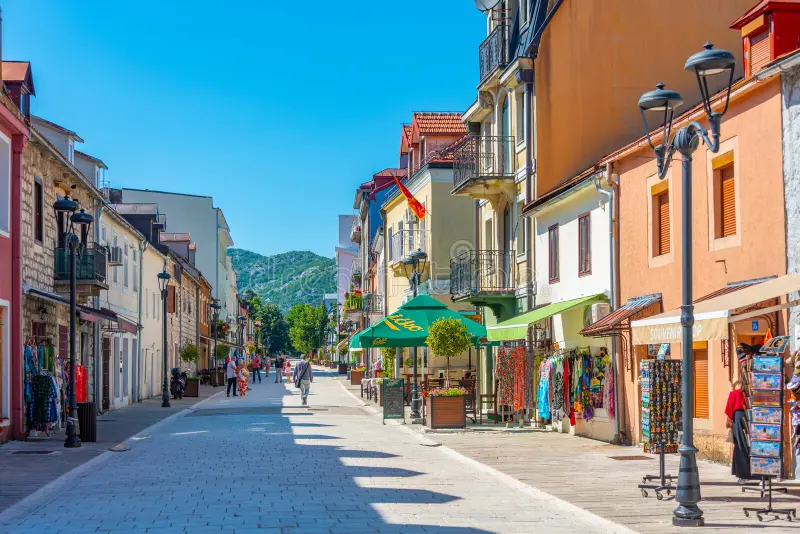
Cetinje's historic centre consists of more than palaces and legations. Rows of single- and multi-storey houses, often with attics, also took shape in the late 19th and early 20th centuries. The houses formed enclosed urban blocks, with facades facing the street and courtyards inside.
This layout links housing and public space: rows of houses are visible from the street, while their courtyards are sheltered within the block. It is a characteristic part of the town's architecture from that period, distinct from later residential and public buildings.
Palaces and former legations
Palaces and foreign legations brought a variety of architectural styles to Cetinje. Their construction reflected the city's governmental and diplomatic role, and foreign architects and builders also contributed to their design. One striking example is the former French Legation, whose facade is covered with multicoloured ceramic tiles. Art Nouveau decoration sets it apart from the simpler town houses.
For individual palaces, legations and other important places, see the attractions in Cetinje.
04The city's public role today
Royal Capital status and the National Library.
The city's public role today
Royal Capital status and the National Library.
The Royal Capital and its institutions today
Cetinje still holds the official status of Royal Capital. Montenegro's Constitution separately designates Podgorica as the capital city and Cetinje as the Royal Capital. The city's historic role also continues through institutions that preserve the national cultural heritage.
The National Library of Montenegro Djurdje Crnojevic occupies the former Italian and French legation buildings. They hold the national book collection, old and rare books and bequeathed collections. Library work and reading rooms give the diplomatic buildings a new function, keeping their heritage connected with research and the use of books.
05Culture and education
The theatre and arts faculties in the city's buildings and sites.
Culture and education
The theatre and arts faculties in the city's buildings and sites.
Culture and arts education
The Royal Theatre Zetski Dom operates as a national professional theatre. Its drama productions sustain the city's role in theatre. The historic building remains a place where contemporary art is created and performed.
Cetinje is also home to the Faculty of Dramatic Arts, the Music Academy and the Faculty of Fine Arts. The Faculty of Dramatic Arts uses the former Turkish Legation, while the Faculty of Fine Arts works on the site of the former Obod factory. Arts education is therefore not confined to the old centre: some of its present-day spaces come from the city's industrial development.
For a meal during your stay, see the recommendations on where to eat in Cetinje. To choose a place to stay overnight, consult the Cetinje accommodation guide.
The city centre and the wider Royal Capital
The square and rows of homes along the streets belong to the compact historic part of the city.
Today, the legation buildings and former factory site are used by the library and faculties.
Separate places within the Royal Capital's wider territory, rather than city neighbourhoods.