01Tivat’s location and climate
The town lies below Vrmac beside Tivat Bay, with warm summers and wetter winters.
Tivat’s location and climate
The town lies below Vrmac beside Tivat Bay, with warm summers and wetter winters.
Tivat on the bay below Vrmac
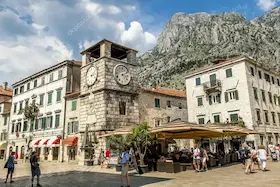
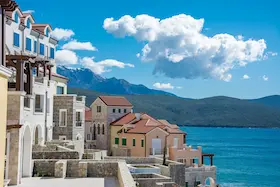
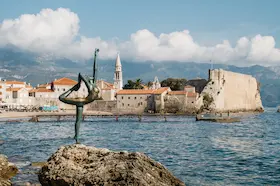
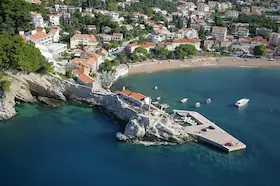
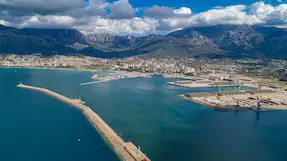
Tivat lies on the southwestern side of Vrmac, beside Tivat Bay. Vrmac forms the hilly backdrop to the town and separates Tivat Bay from Kotor Bay. Donja Lastva, Seljanovo and Mrcevac lie at its foot on the Tivat side, while villages and old roads are found higher up the slopes. The town’s waterfront and the villages above it therefore differ in both appearance and access.
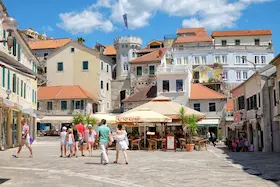
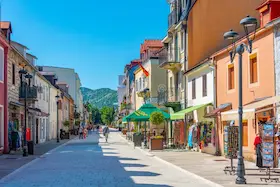
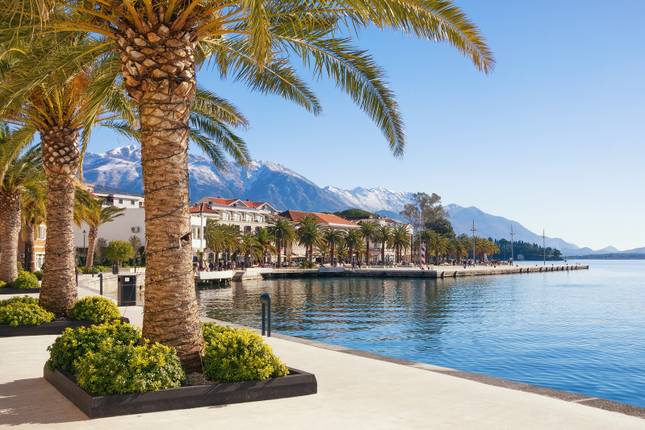
Pine is the town’s central waterfront, lined with buildings and a promenade facing the bay. The wider Tivat Bay also takes in shores beyond the town itself, with other settlements, peninsulas and islands. Staying beside the town’s waterfront therefore puts you in a different setting from staying elsewhere on the bay or in a village on Vrmac.
Warm summers and rainy winters in Boka Kotorska
Tivat has a Mediterranean climate with warm summers and mild, wetter winters. The maestral is common in summer, blowing into the bay from the northwest. In winter, the bura brings cooler air from the northeast.
The jugo is associated with warmer, cloudy and rainy weather. A mild winter therefore does not mean consistently calm conditions by the sea. Rain and wind can affect how much time you spend on the waterfront, while summer and winter also differ in how much of the cultural programme takes place outdoors.
02From summer residences to Arsenal
Older estates and summer residences preceded the shipyard alongside which modern Tivat grew.
From summer residences to Arsenal
Older estates and summer residences preceded the shipyard alongside which modern Tivat grew.
Estates and summer residences before the industrial town
Before Arsenal developed, the nobility of Kotor and Perast owned estates along Tivat’s coast and in its hinterland. Summer residences were built on them from the Middle Ages onwards. Residential buildings and family chapels stood alongside gardens, vineyards and orchards, with outbuildings for processing and storing produce. A summer residence was therefore part of a cultivated estate connected to both farming and the sea.
The Buca-Lukovic complex in central Tivat retains the features of such a fortified estate. Its buildings, tower and Chapel of St Michael stand within a stone enclosure wall. The buildings were constructed and altered in several periods, leaving visible differences within the complex. Today’s museum and gallery spaces make use of this older part of the town’s heritage.
Arsenal and the development of modern Tivat
In 1889, the municipal council granted land for the construction of Arsenal. The growth of the naval shipyard transformed an area where farming had previously played an important role. Repairing and maintaining ships required craftspeople, engineers and industrial workshops, and modern Tivat developed alongside Arsenal.
After the Second World War, the shipyard continued operating as the Sava Kovacevic Naval Technical Repair Institute. The jobs it provided mattered to the town and its economy. The later conversion of the site into Porto Montenegro brought a different use to the waterfront, with a marina and tourist development. Workshops and ship repairs gave way to berths, housing and tourism services.
03The park and the town’s waterfront
The Naval Park, central waterfront, Kalimanj and converted industrial shoreline have different origins and uses today.
The park and the town’s waterfront
The Naval Park, central waterfront, Kalimanj and converted industrial shoreline have different origins and uses today.
Tivat City Park and the town’s maritime past
Tivat City Park was created in 1892, during the development of Arsenal. It was laid out on land formerly occupied by the estates and summer residences of the Radali and Verona families. A memorial in the park records its creation. The navy maintained the park for many years, which is why it is also known as the Naval Park.
Its trees include pines, eucalyptus, magnolias and cypresses. The park has preserved greenery in a place where the waterfront and town changed under the influence of industry and, later, tourism.
Pine, Kalimanj and the former Arsenal site
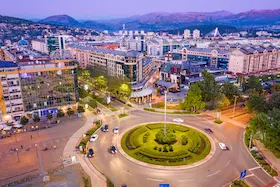
Tivat’s waterfront consists of several distinct areas. Pine is the central waterfront, with a promenade and town buildings beside the sea. Here, the town centre opens directly onto the bay.
Kalimanj is a sheltered town harbour set into the land, mainly serving local residents’ smaller boats. Its narrow entrance and recessed position provide shelter from currents and winds. Its appearance and purpose differ from those of the broad waterfront and the marina for large yachts.
Porto Montenegro now occupies the former Arsenal site, with a marina, housing and tourist facilities. Its buildings and berths show the new use of what was once an industrial waterfront.
04Culture in Tivat
Museum collections preserve the town’s heritage, while the gallery and Cultural Centre present contemporary art, theatre and music.
Culture in Tivat
Museum collections preserve the town’s heritage, while the gallery and Cultural Centre present contemporary art, theatre and music.
Museum collections and theatre in Tivat
Tivat Museum and Gallery occupies the Buca-Lukovic complex. The museum holds ethnographic material relating to life in the area, including traditional dress and objects used in traditional crafts. The gallery programme presents contemporary visual art. Elsewhere on the town’s waterfront, the Naval Heritage Collection holds objects connected with the former Arsenal, ships and the work of the shipyard. These offer different views of the town’s past, from households and crafts to the naval industry.
Tivat Cultural Centre has a large hall for theatre performances, concerts and film screenings throughout the year. In summer, some events take place on outdoor stages. Purgatorije is a summer festival with theatre and music programmes. For specific dates and venues, see the official Tivat Cultural Centre programme.
05A brief look at Tivat’s attractions
The town’s institutions and park differ from the villages and other places around the bay.
A brief look at Tivat’s attractions
The town’s institutions and park differ from the villages and other places around the bay.
From the town’s waterfront to the surrounding area
Buca-Lukovic, Tivat City Park and the Naval Heritage Collection offer different ways to continue getting to know the town. Older villages lie on Vrmac, including Gornja Lastva, whose setting differs from that of the waterfront. The guide to Tivat’s attractions describes individual places in the town and surrounding area, with information about visiting them.
For a meal, the restaurant recommendations for Tivat point to specific places to eat. When choosing where to stay overnight, the accommodation guide compares parts of the town and nearby settlements.
Pine, Kalimanj and the former Arsenal
A promenade and town buildings beside the sea in central Tivat.
A sheltered area for smaller boats with a narrow entrance from the bay.
The shipyard site now occupied by the Porto Montenegro marina and development.