
Ostrog by car from Podgorica: monastery visits
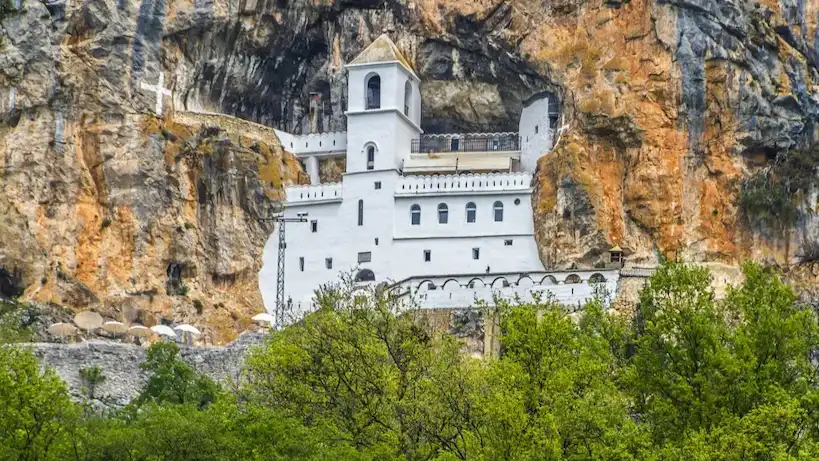
Ostrog is one of the most visited monasteries in the Balkans, with its Upper Monastery built into an almost vertical cliff above the Bjelopavlici Plain. Inside the cave churches, frescoes follow the contours of the natural rock. Outside, the terraces overlook the Zeta Valley. Saint Basil of Ostrog established the monastery in the 17th century around the older Church of the Presentation of the Virgin Mary. His relics are kept in that church, where pilgrims of different faiths come to pay their respects.
Trip overview
- Trip duration
- About 9 to 10 hours
- Number of stops
- 4
- Route distance
- About 90 km
Why set aside a day for this trip
Ostrog lets you see, at close quarters, what it took to create a sanctuary in a near-vertical cliff that people have visited for centuries. That achievement gives you a reason to come even as a tourist, without the intention of taking part in a pilgrimage. The pilgrims of different faiths who still visit show how much the place means to people: during your visit, you encounter a tradition that continues today. Giving Ostrog a day leaves time to stay and look around the monastery. Starting from Podgorica makes that possible: most of the day remains available for visits and a break.
Trip and costs at a glance
| Item | Trip overview |
|---|---|
| Trip duration | About 9 to 10 hours |
| Transport | Car required · rental offers |
| Sights on this trip | |
| Fuel consumption | About 7 to 9 liters |
| Tolls | No charge |
| Admission costs | No charge |
| Navigation | Open the complete route for navigation |
Map and navigation

Route, visits and breaks
Driving and visiting times are approximate. The total trip includes extra time for queues at the reliquary, parking and a slower approach.
01Leaving Podgorica and visiting Zdrebaonik
45 min driving · 45 min visiting
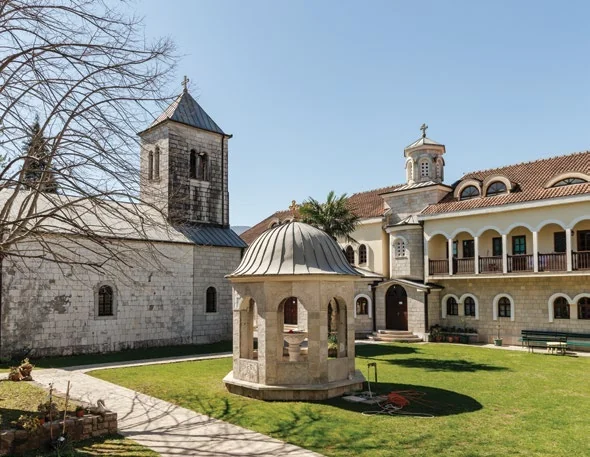
Leave Podgorica in the morning. Open the prepared route for navigation, which takes you via Zdrebaonik to the higher parking area and back along the same approach. If you enter the destinations yourself, add Danilovgrad, Zdrebaonik Monastery in Sekulici, then the parking area below Upper Ostrog, in that order. Danilovgrad is a place you pass through. Zdrebaonik is your first visit.
Leave your car in the parking area in front of the monastery courtyard. Enter the Church of Saint Michael the Archangel, spend time at the reliquary of Saint Arsenije, look at the iconostasis, then walk around the courtyard. After your visit, continue towards Ostrog.
02Continuing the drive and visiting Upper Ostrog
45 min driving · 30 min on foot · 1 h 45 min visiting
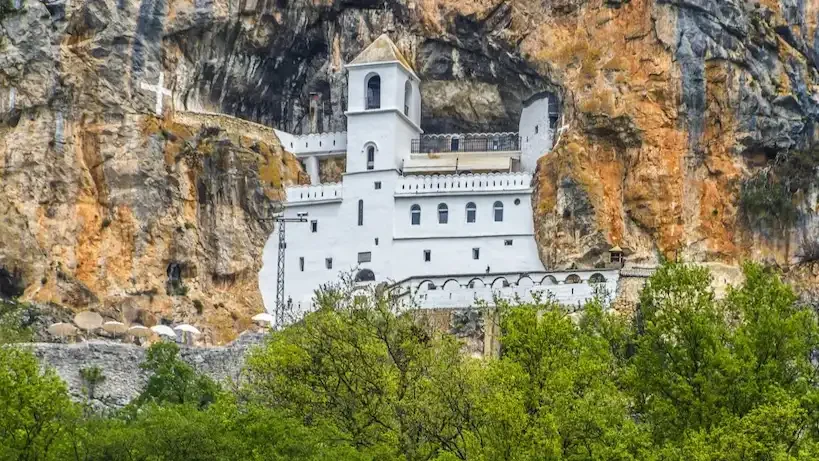
From Zdrebaonik, the road climbs out of the Bjelopavlici Plain, passes the Lower Monastery and continues along a more winding stretch towards the Upper Monastery. The final bends and passing vehicles call for slower driving. On an ordinary day, this paved approach is used in both directions. Follow the traffic instructions in force when you arrive. Leave Lower Ostrog for the descent so that your main visit begins earlier.
The higher parking area is separate from the monastery entrance, and the approach on foot includes an uphill walk. Traffic arrangements that day determine how far up you may drive. The trip estimate assumes access to the higher parking area, without promising a space at the monastery doors.
At Upper Ostrog, visit the Church of the Presentation first, following the queue and the monastic community’s instructions. Then visit the Church of the Holy Cross and the terraces connected by stairs through the rock, including the area beside the Ostrog vine. Leave time on the terraces to look across the valley. Extra time for longer queues is included in the total trip duration.
03Driving down and visiting Lower Ostrog
15 min walk to the car · 15 min driving · 1 h visiting
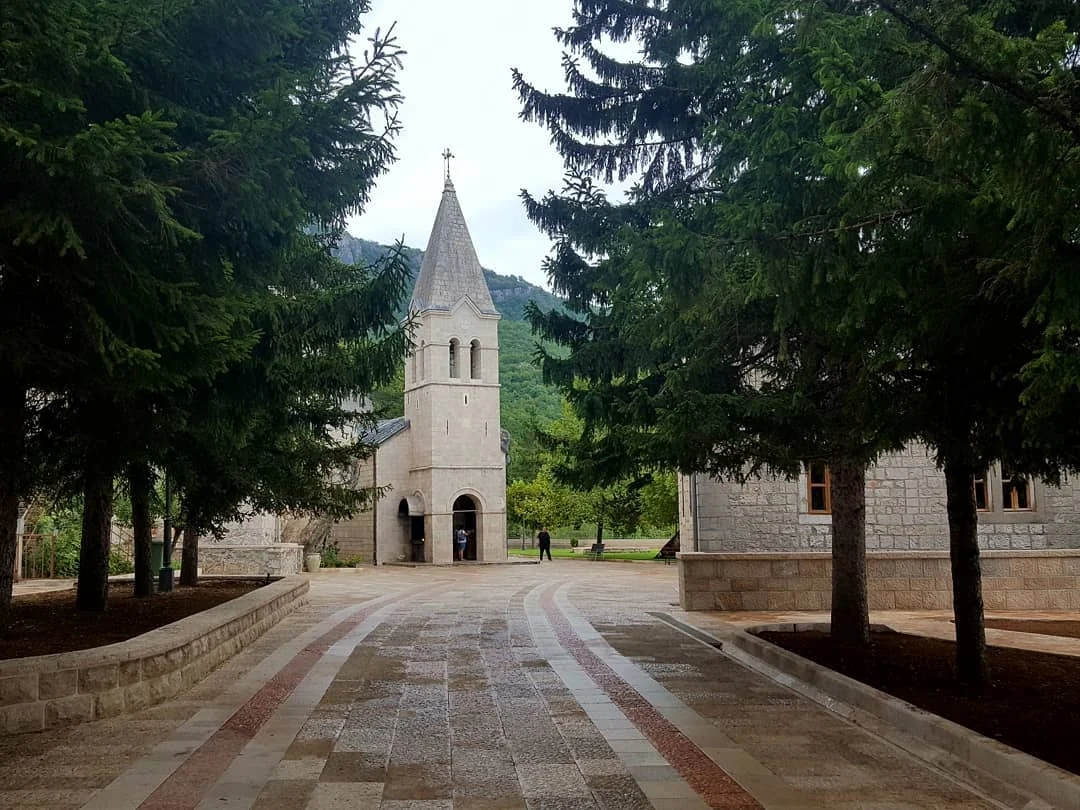
After visiting the Upper Monastery, walk back to your car, then drive down to the parking area at Lower Ostrog.
Start in the courtyard and visit the Church of the Holy Trinity, then continue to the Church of Saint Stanko on the rock above it. Include the courtyard with its water source and the view from the enclosed plateau in your visit.
04Lunch with a view at Sokoline
10 min driving · 1 h for lunch and a break
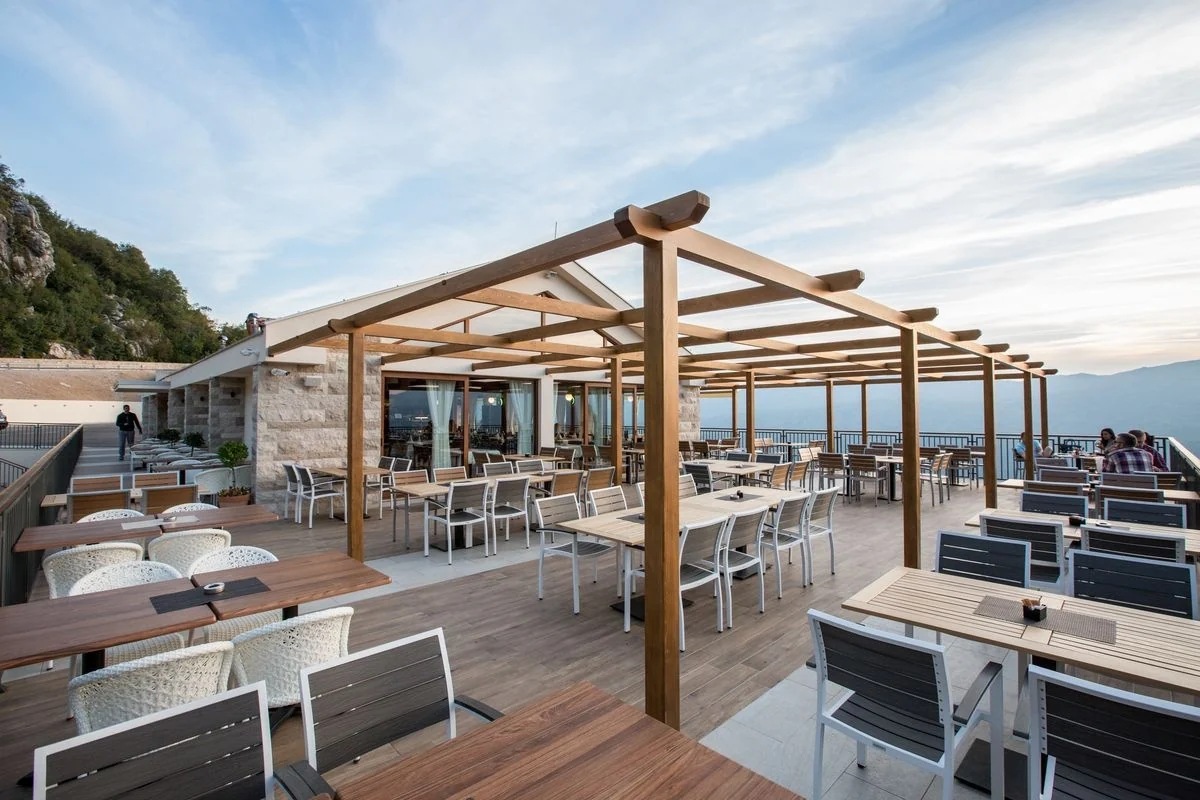
After Lower Ostrog, continue down the same approach to Sokoline Restaurant. It is approximately two kilometers below the Lower Monastery, on the road towards Zdrebaonik, so this break does not require a separate detour. There is parking for guests.
The terrace overlooks Upper Ostrog in the cliff and the Bjelopavlici Plain below. After seeing the monastery close up, you can take in its setting on the slope above the valley. The restaurant serves Mediterranean and international dishes.
05Returning to Podgorica
1 h 15 min driving
From Sokoline, head back towards Zdrebaonik, then return to Podgorica via Danilovgrad. Keep Zdrebaonik as a waypoint in your navigation, without stopping at the monastery again.
Allow about 9 to 10 hours for the full trip, including visits, parking, the approach on foot, lunch and extra time for delays. This estimate applies to a day outside the feast-day gathering, with access to the higher parking area permitted.
Trip highlights
01Zdrebaonik and the relics of Saint Arsenije
Zdrebaonik stands in Sekulici, on the left bank of the Zeta near Danilovgrad. Its main church is dedicated to Saint Michael the Archangel and holds the relics of Saint Arsenije of Srem, the second Serbian archbishop and successor to Saint Sava. The reliquary beside the church’s south wall is therefore the focus of veneration and the main reason pilgrims come.
The present church was built in 1818 on the foundations of an older church. An inscription above the entrance records its construction and the later addition of the bell tower. One of the distinctive features inside is the iconostasis by the Djinovski brothers. Its structure is masonry, with vine decoration modeled in plaster rather than the usual carved wood.
The church stands in the middle of the courtyard, with monastery residences to the sides. Zdrebaonik has been home to a community of nuns since 1991. The residential buildings are used by the community, while visitors spend time in the church and courtyard.
02Upper Ostrog and the origins of the cave monastery
Before the present monastery, monks and hermits lived in the caves of Ostroska Greda. Monastic tradition remembers Isaija of Onogost among them, while the older Church of the Presentation is associated with that early community.
Saint Basil came here as the metropolitan of Herzegovina, during Ottoman rule and a period of pressure on his diocese. Working with the monastic community, he restored the older church and built the monastery, contributing his labor and property. Ostrog was both a place of prayer and the seat from which he continued to direct church affairs. The second cave church, the Holy Cross, was built with his blessing. Abbot Isaija oversaw the work. His name survives in the inscription above the door.
Basil spent the final years of his life at Ostrog. After his death, he was first buried beneath the Church of the Presentation. His relics were later moved into the church. Believers venerate him as a miracle worker and attribute healings to his prayers. Ostrog retains that importance as a place of pilgrimage today. Visiting the reliquary, the casket containing his relics, is an act of veneration that takes place alongside prayer and worship.
Of Upper Ostrog’s two cave churches, the older is the Church of the Presentation of the Virgin Mary. Its frescoes follow the uneven walls of the cave, leaving the natural rock visible within the church itself. The figures depicted include Saint Sava, Emperor Constantine and Empress Helena.
The Church of the Holy Cross stands on a higher terrace. A surviving inscription records its construction in 1665 and its painting in 1667. The painter Radul adapted his compositions to the stone, without the regular wall surfaces found in churches built outside caves.
The fire of 1923 spared both cave churches. The exterior of the Upper Monastery and the bell tower were rebuilt afterwards, so the present facade does not mean that the frescoes inside date from the same period.
The Ostrog vine grows beside the upper terraces. Tradition links its location to Basil’s cell and the place of his death. From the terraces above the Zeta Valley, you can see the Bjelopavlici Plain.
03Lower Ostrog, the Holy Trinity and Saint Stanko
Lower Ostrog stands on a plateau below the cave monastery. Its courtyard contains the Church of the Holy Trinity, built in 1824 on the site of an earlier village church. The residences and other monastery buildings around it show how the Ostrog community expanded beyond the cliff hermitages and welcomed pilgrims.
On the rock above the Holy Trinity stands the Church of Saint Stanko the New Martyr. It was consecrated in 2004, when his relics were transferred there: his preserved hands, previously kept at Upper Ostrog. The monastery’s account of his life describes Stanko as a boy who tended sheep. Local tradition connects his origins with villages below Ostrog and his martyrdom with the period of Ottoman rule.
The courtyard has monastery residences and a water source, while the enclosed plateau overlooks the Bjelopavlici Plain.
Questions before visiting Ostrog
How demanding is the climb if I park at Lower Ostrog?
The two monastery levels are connected by a road approximately three kilometers long, with pedestrian shortcuts cutting across the bends. Walking all the way up from Lower Ostrog and back down to your car involves considerably more walking than the final approach from the higher parking area. Consider the slope and stairs carefully if you are traveling with children or someone with limited mobility. The trip duration assumes you can drive to the higher parking area. It is not an estimate for the full ascent and descent on foot.
Is Saint Basil’s feast day a good time to visit?
Large numbers of pilgrims arrive around May 12. The visit has particular religious significance then, but waiting times are much longer. For a sightseeing trip with lunch and a planned return, choose a day outside the feast-day gathering. If you want to attend the feast, check the monastery’s latest announcements and police notices, as temporary traffic arrangements may change the access route.
What should I wear, and can visitors of other faiths come?
Yes. People of different faiths visit Ostrog, but it is a working monastery where prayer and services take place. Clothing should cover shoulders and knees. Follow the instructions about photography and moving around inside the churches, especially during services.
More day trips from Podgorica
Biogradska Gora by car from Podgorica, lake and old-growth forest
Visit Morača Monastery and walk the full circuit around Biogradsko Lake through old-growth forest. A day trip by car from Podgorica with lunch in Kolašin, costs and a highway return.Lakes and Katuns of the Kucke Mountains from Podgorica
A trip to Lake Bukumirsko and Mokra, with a walk through the katun at Sirokar to a viewpoint overlooking Lake Rikavacko. Driving access, timing and costs for the full day.Cetinje and Lovcen by car from Podgorica, with a cable car ride
Visit the royal palace in Cetinje and Njegos's Mausoleum, then take a cable car ride from Kuk. A full day out with lunch, costs and a prepared route for navigation.Krug oko Korita from Podgorica, Medun and Grlo Sokolovo
Drive the Krug oko Korita from Podgorica, with Medun and the Marko Miljanov Museum, a loop walk to Grlo Sokolovo and views from Delaj. Trip duration, costs and navigation.Lake Skadar by car from Podgorica, viewpoint and boat trip
From Pavlova strana and Danilo's Bridge to a boat trip from Virpazar. A day trip by car from Podgorica with time for the lake, lunch and the drive back.Open a dedicated Podgorica guide for arrival, accommodation, food, sights or practical questions during your stay.
Guides to other places in Montenegro
Cetinje
Open guide
Petrovac
Open guide
Budva
Open guide
Kotor
Open guide
Bar
Open guide
Tivat
Open guide
Ulcinj
Open guide
Herceg Novi
Open guide
Igalo
Open guide
Zabljak
Open guideDrives and day trips from nearby destinations
Use the Montenegro guide to see how the coast, Lake Skadar or the north fits the number of days you have, with realistic travel times and suitable transport.
