
Zabljak neighbourhoods: the centre, Tmajevci and Mezdo
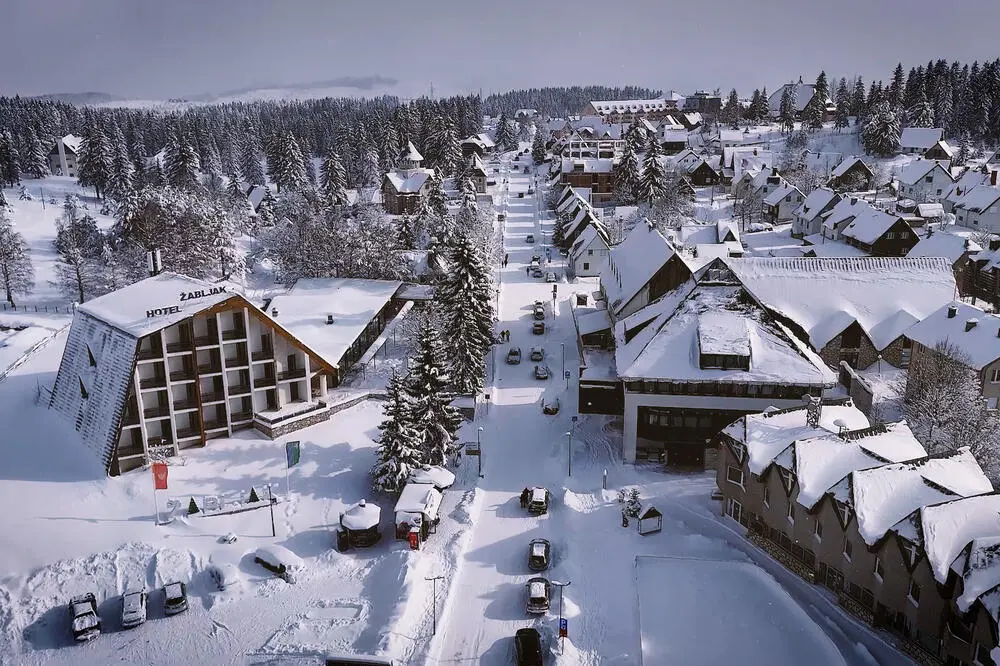
Zabljak’s centre grew from a row of houses along a road into a town centre with apartment blocks, a hotel and public buildings. In Tmajevci and Mezdo, development centred on detached houses in their own plots, from low holiday cottages to taller homes with balconies.
How the town took shape
- Town centre
- Houses and larger town buildings
- Tmajevci and Mezdo
- Detached houses in their own plots
Homes and tourism across the town
Plans for the centre aimed to keep apartments, shops and shared spaces close together. In Tmajevci and Mezdo, holiday homes and houses rented to guests became part of tourist accommodation.
01Zabljak town centre
Zabljak’s core developed as a row of family homes along the main road. Houses were built on small plots, and homes with an upper floor and an attic appeared alongside older single-storey buildings. Apartment blocks several storeys high, with pitched metal roofs, were built in the same central area. The photograph above shows smaller houses interspersed with much larger buildings and the roof of Hotel Zabljak.
Mileta Bojovic helped shape the town centre as the architect behind urban plans for Zabljak and several buildings constructed in the town. In planning the tourist centre, he sought to bring housing and services close together, with shared spaces for residents and guests. Covered pedestrian passages were part of the response to rain, wind and snow.
His Robna kuca residential and commercial complex was built beside the town square. Its upper floors project beyond the ground floor, where a long covered walkway runs along the building. The design brought apartments, shops and public services together in one building. Pedestrian passages linked the street side to a shopping and crafts centre, while a shared passage with a partly covered terrace was built inside the building. Its shallow, gently sloping roof was designed to keep views of Durmitor as open as possible from tourist buildings planned across the street.
Later, the garage was converted into firewood storage and the nursery into an apartment. Covered spaces along the street began to be used for parking instead of pedestrian access.
Read more about Zabljak’s development and the relationship between the centre and other parts of town in our About Zabljak guide.
02Tmajevci and Mezdo
Tmajevci and Mezdo are residential areas on the way out of Zabljak towards Djurdjevica Tara. Detached family homes shaped their development. They were built on individual plots, where larger houses with one or two upper floors appeared alongside single-storey homes. Some houses served as holiday homes for their owners, while others accommodated guests.
On some smaller houses, the roof extended down almost to ground-floor level, giving the whole building a pronounced triangular shape. Some taller houses had balconies running across the entire front facade. On some buildings, a stone or rendered lower section was combined with wooden cladding above. In Tmajevci, sheet metal was used for roofs and facades.
Parts of the plots between the houses in Tmajevci and Mezdo remained grassy, and some small holiday cottages were grouped around shared paths. Houses are still used as guest accommodation in both areas. In Mezdo, entire houses with their own yards are rented out, while in Tmajevci guests also stay in a family home as part of a rural homestay.
Would you like more stories about Zabljak?
Keep exploring Zabljak through local stories and guides to the town and surrounding area.
For the rest of your stay, choose a guide to arrival, accommodation, food, attractions, or trips from Zabljak.
Guides to other towns
Podgorica
Open the city guide
Kotor
Open the city guide
Cetinje
Open the city guide
Tivat
Open the city guide
Herceg Novi
Open the city guide
Igalo
Open the city guide
Budva
Open the city guide
Petrovac
Open the city guide
Bar
Open the city guide
Ulcinj
Open the city guideLocal stories from other towns
Connect your stay in Zabljak with other mountain and coastal towns, airports, and practical information for the rest of the country.
