01Walls, the Citadel and old churches
The Old Town and town walls
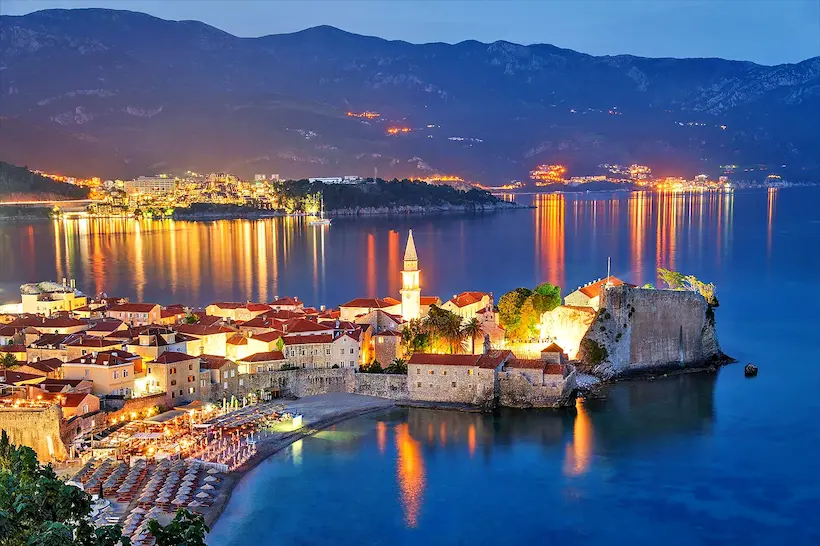
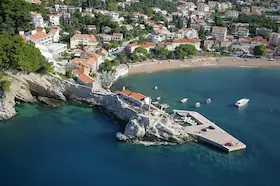
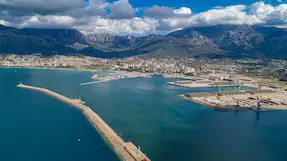
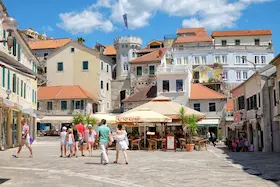
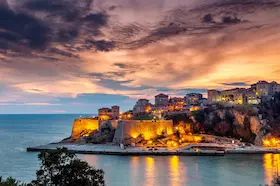
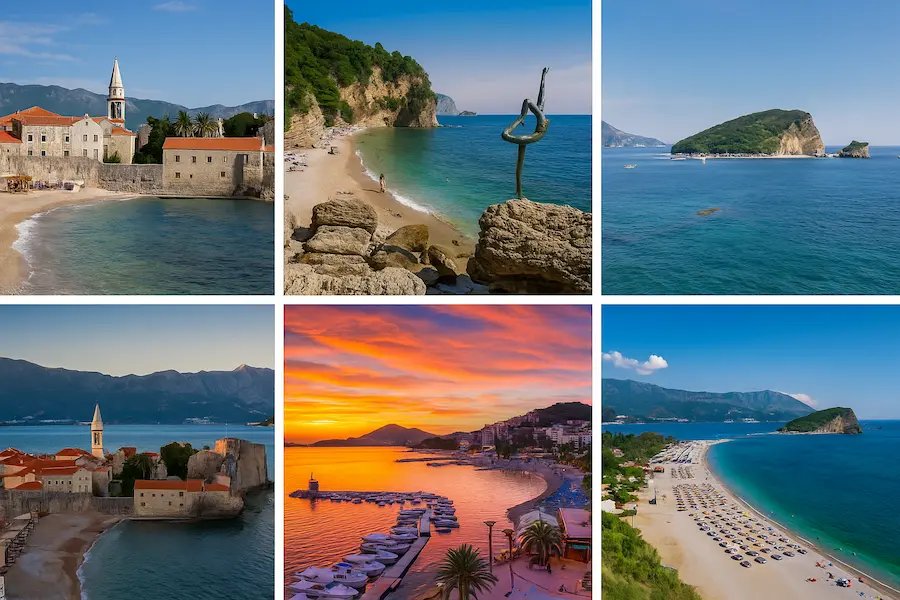
Budva's Old Town occupies a small peninsula beside the harbour, with its stone walls standing directly along the shore. From the walkway on the ramparts, you can see red roofs, narrow streets and squares inside the fortified perimeter, together with the bay outside it. This differs from the view through passages between the houses, where the walls often appear only as the end of a street or the frame of a town gate.
The Gradenigo and Repeno towers stand out along the northern perimeter. Their thick walls, defensive openings and corner positions explain how the approaches to the town were guarded. Today's ramparts retain Venetian additions, later alterations and repairs after the earthquake. For the wider history of those changes, continue to medieval and Venetian Budva.
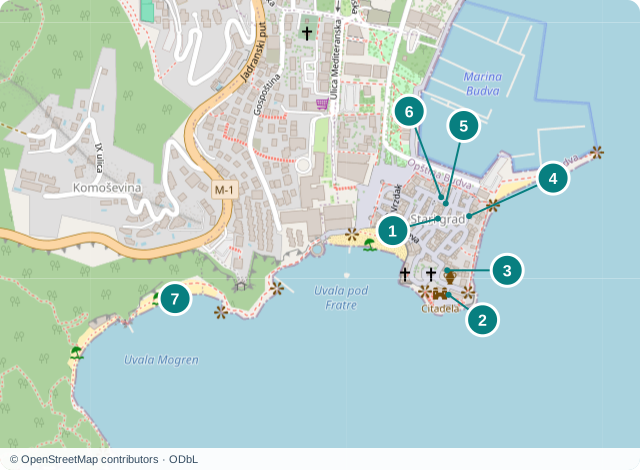
The Old Town streets and the walkway on the walls are separate visits. The entrance to the ramparts is on the platform beside the Citadel, at the southern end of the historic centre. The stone staircase along the western wall is described as a way down. Expect steps on the elevated walkway, unlike a walk through the streets below it.
Visit: According to the institution's published schedule, the walls are open daily from 10:00 to 20:00, from April to November. Admission costs €2 and includes a brochure. This schedule applies to the town walls, rather than the Citadel.
Admission to the town wallsThe Citadel
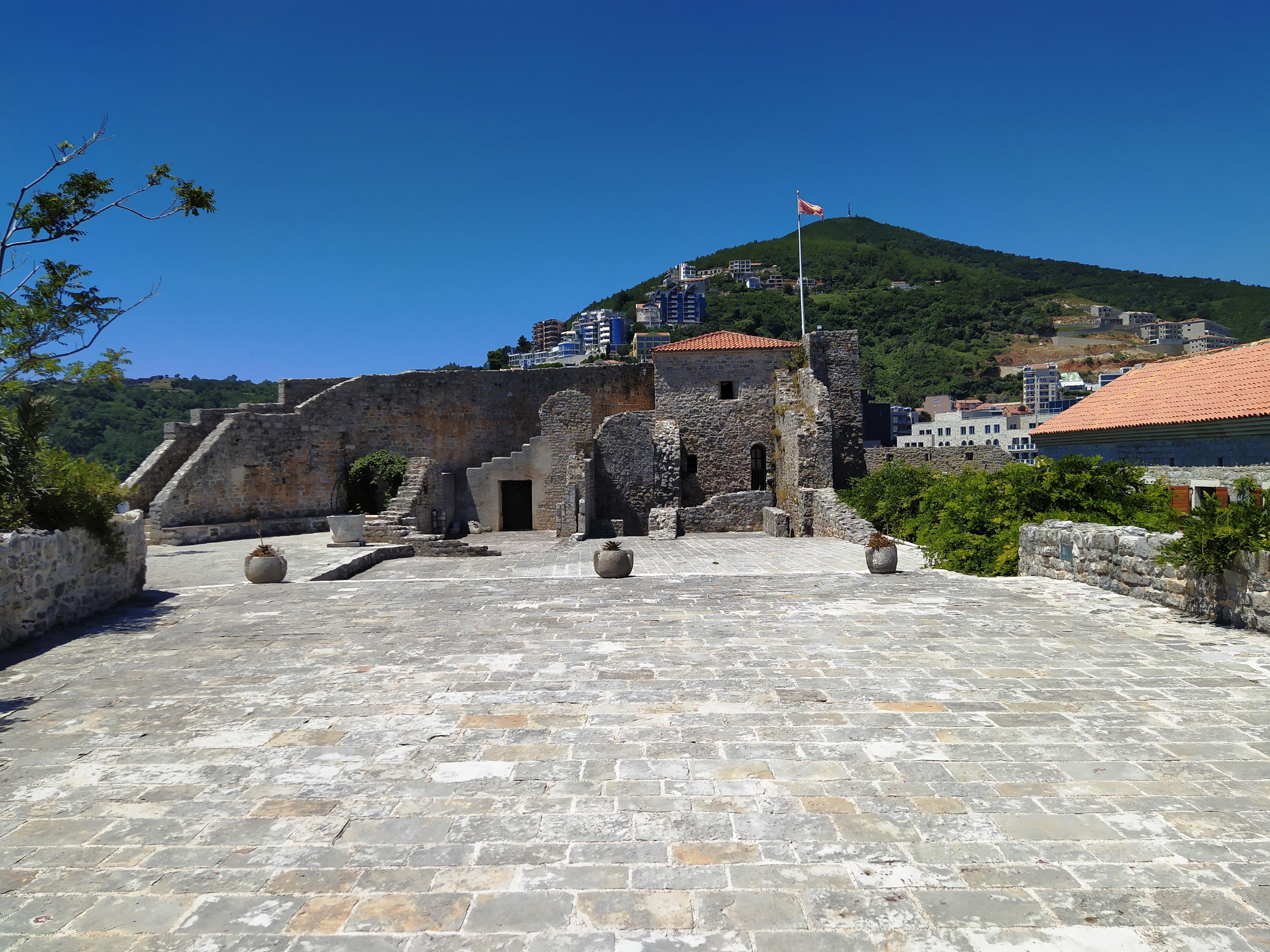
The Citadel is a separate fortress at the southern end of the Old Town, with tall stone walls facing the open sea. Its perimeter encloses a military building, a medieval tower and the remains of a church, so a visit includes more than a viewpoint over the bay. This compact group of buildings shows how a smaller protected space could serve as a final stronghold within an already fortified town.
The donjon is a sturdy medieval tower intended for the last line of defence. The barracks belong to a later military arrangement, while the walls of the former Santa Maria de Castello church were incorporated into subsequent construction. Parts of its walls and apse, the area beside the altar, survive, but the complete interior has not been preserved.
The Citadel's appearance developed through medieval, Venetian and Austrian alterations, with restoration in more recent times. It has its own visiting arrangements. The opening hours and ticket for the town walls do not apply to this complex, and the interior rooms available to visitors depend on what its operator offers.
Entry: The Citadel has a separate operator. Before entering, check which areas are included in the visit offered and the current conditions at the entrance.
Description of the Citadel complexChurches at the southern end of the Old Town
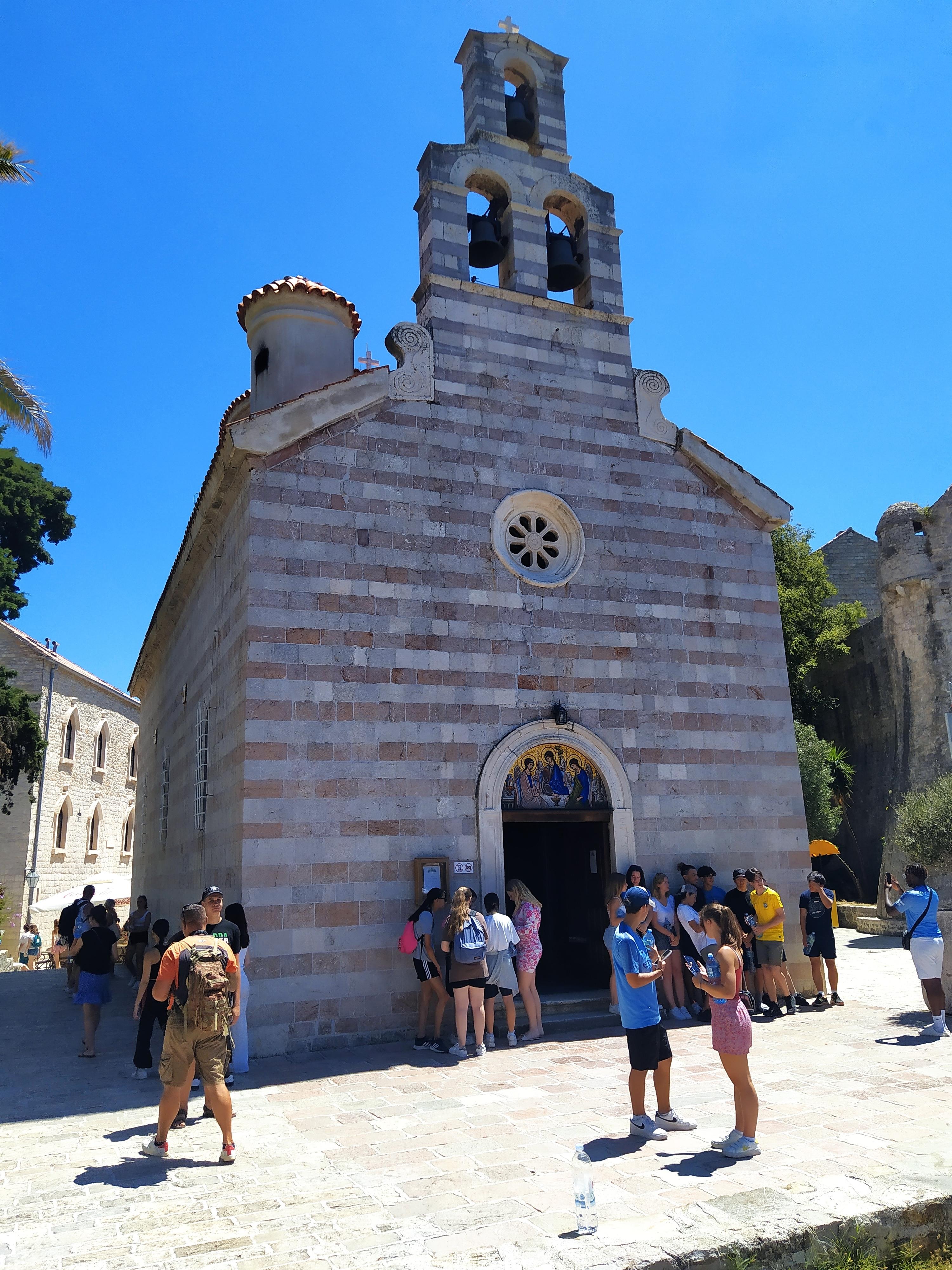
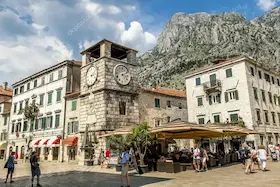
At the southern end of the Old Town, around the squares in front of the Citadel, the tall bell tower of St. John stands close to much smaller stone churches. They are distinguished by the bands of white and reddish stone on the Holy Trinity church, the low stone building of Santa Maria in Punta and the small Church of St. Sava the Sanctified, which has no bell tower.
The Catholic Church of St. John the Baptist was Budva's cathedral until the diocese was abolished in 1828. The present complex includes the church, bell tower and bishop's palace. Inside, side chapels complement the main space, and the icon of Our Lady of Budva is kept on the northern altar. The church's early origins do not mean that everything you see today dates from a single period.
The Orthodox Church of the Holy Trinity was completed in 1804. Its facade is built with alternating bands of stone, and inside is a tall screen of icons, the iconostasis, painted by Naum Zetiri in 1833. The grave of Stefan Mitrov Ljubisa is in front of the church.
Santa Maria in Punta is connected to the town walls on the southwestern promontory. An inscription in its wall refers to the year 840, while bell towers added later show subsequent changes. Beside it stands the Church of St. Sava the Sanctified, a small Romanesque building with a single nave and a semicircular apse. Restoration uncovered an inscription from 1141 and damaged wall paintings beneath the plaster. Seeing these exterior features does not mean that every church's interior is open throughout the day.
02A museum, gallery and literary memorial
Budva City Museum
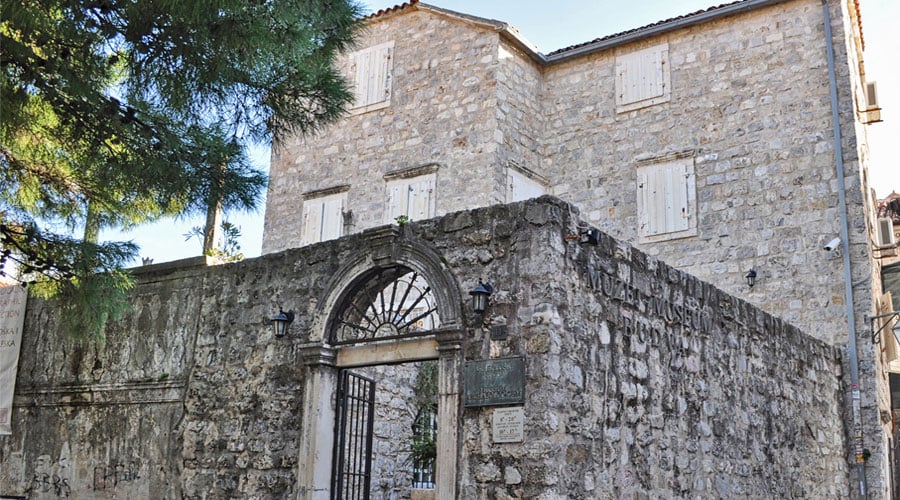
Budva City Museum occupies an old town house at 11 Petra I Petrovica Street, with a large arched portal and a courtyard containing a bistijerna, a water cistern. Its archaeological and ethnographic displays present objects from different periods. Vessels, jewellery and equipment bring the town's former inhabitants closer through the things they used and wore.
The collections include finds from Budva's necropolis: Greek clay vessels and gold jewellery, Roman stone urns and other objects. Their materials and workmanship reveal details of ancient life that cannot be learned simply by looking at the walls. The ethnographic material documents life in the area in later periods, including fishing equipment and navigation instruments. Collections and displays are different things, so the number of objects the institution holds does not determine how many are exhibited during your visit.
The building itself also has features worth noticing. Above the entrance is a coat of arms with a fox and the year 1825, while an area for stone archaeological finds has been arranged along its eastern side. This is a lapidarium, a space containing stone monuments and architectural fragments. The museum thus combines viewing objects with seeing the older town house in which they are kept.
Visit: According to the institution's published schedule, the museum is closed on Mondays. It opens Tuesday to Friday from 08:00 to 22:00, and on Saturdays and Sundays from 14:00 to 21:00. Adult admission costs €5, the rate for a group of at least five visitors is €4, and children aged 12 to 18 pay €3. Children under 12 enter free.
Museum admission and opening hoursJovo Ivanovic Modern Gallery
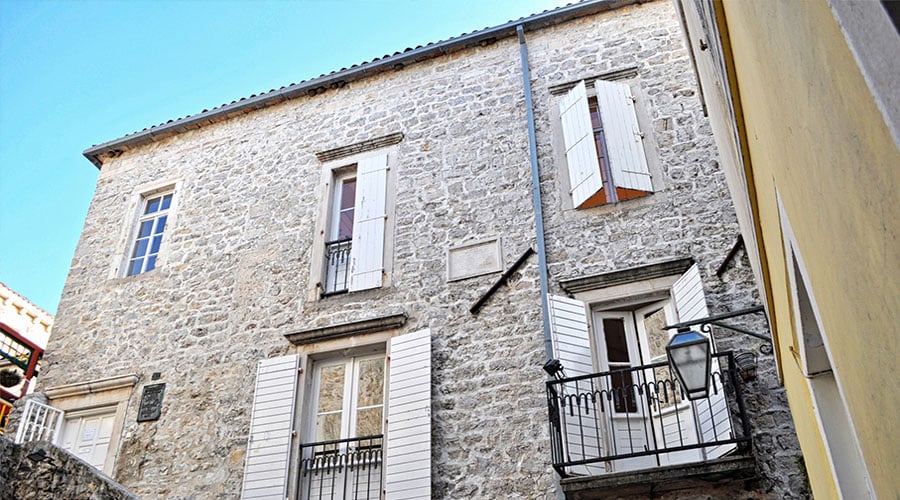
Jovo Ivanovic Modern Gallery is in the Old Town, at 19 Cara Dusana Street, where it hosts solo and group art exhibitions. Paintings, drawings, sculptures or other works depend on the exhibition, giving this space a different focus from the archaeological museum. The exhibition currently open determines what you see during a visit. The gallery's holdings also include works that are not on public display at that time.
The institution holds collections of Montenegrin art, local art, art from abroad and naive art, as well as a collection of contemporary expressionists. It has borne the name of its founder, Jovo Ivanovic, since 2018. Current gallery announcements show which artist and theme are featured during a particular visit.
Visit: According to the institution's published schedule, admission to the Modern Gallery is free. It opens on Mondays from 08:00 to 14:00, Tuesday to Friday from 08:00 to 14:00 and from 17:00 to 21:00, and on Saturdays and Sundays from 17:00 to 21:00.
Modern Gallery opening hoursStefan Mitrov Ljubisa Memorial House
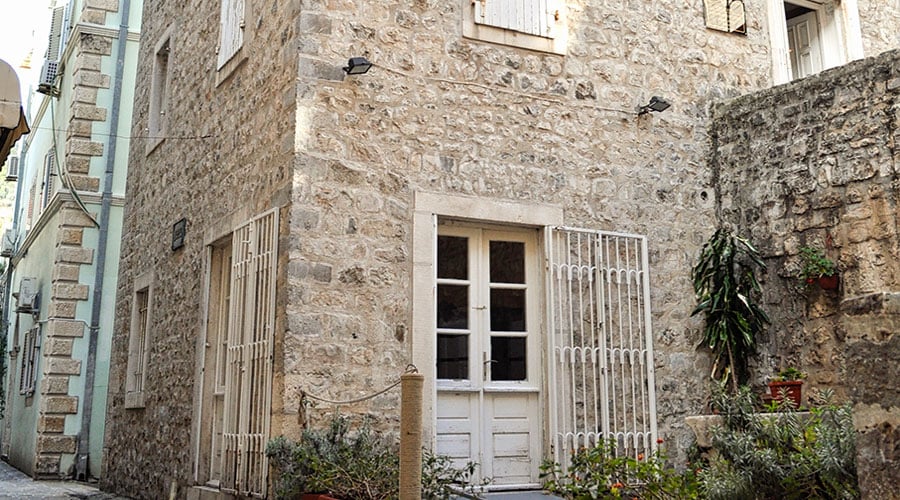
Stefan Mitrov Ljubisa Memorial House is in the writer's birthplace at 13 Cara Dusana Street. First editions and documentary material present his literary work and public life.
Stefan Mitrov Ljubisa was a writer and political representative of this area. The memorial, opened in 1995, preserves documents about his work in Budva's municipality and the Dalmatian Assembly, correspondence and editions of his works. The first editions include four volumes of "Pricanja Vuka Dojcevica".
The Memorial House's gallery space also hosts documentary and art exhibitions. When choosing a visit, distinguish the memorial collection from the exhibition announced for that time, which may have a different theme.
Visit: According to the institution's published schedule, admission to the Memorial House is free. It opens on Mondays from 08:00 to 14:00, Tuesday to Friday from 08:00 to 20:00, and on Saturdays and Sundays from 17:00 to 21:00.
Memorial House opening hours03The Mogren coast and the island facing the town
Mogren
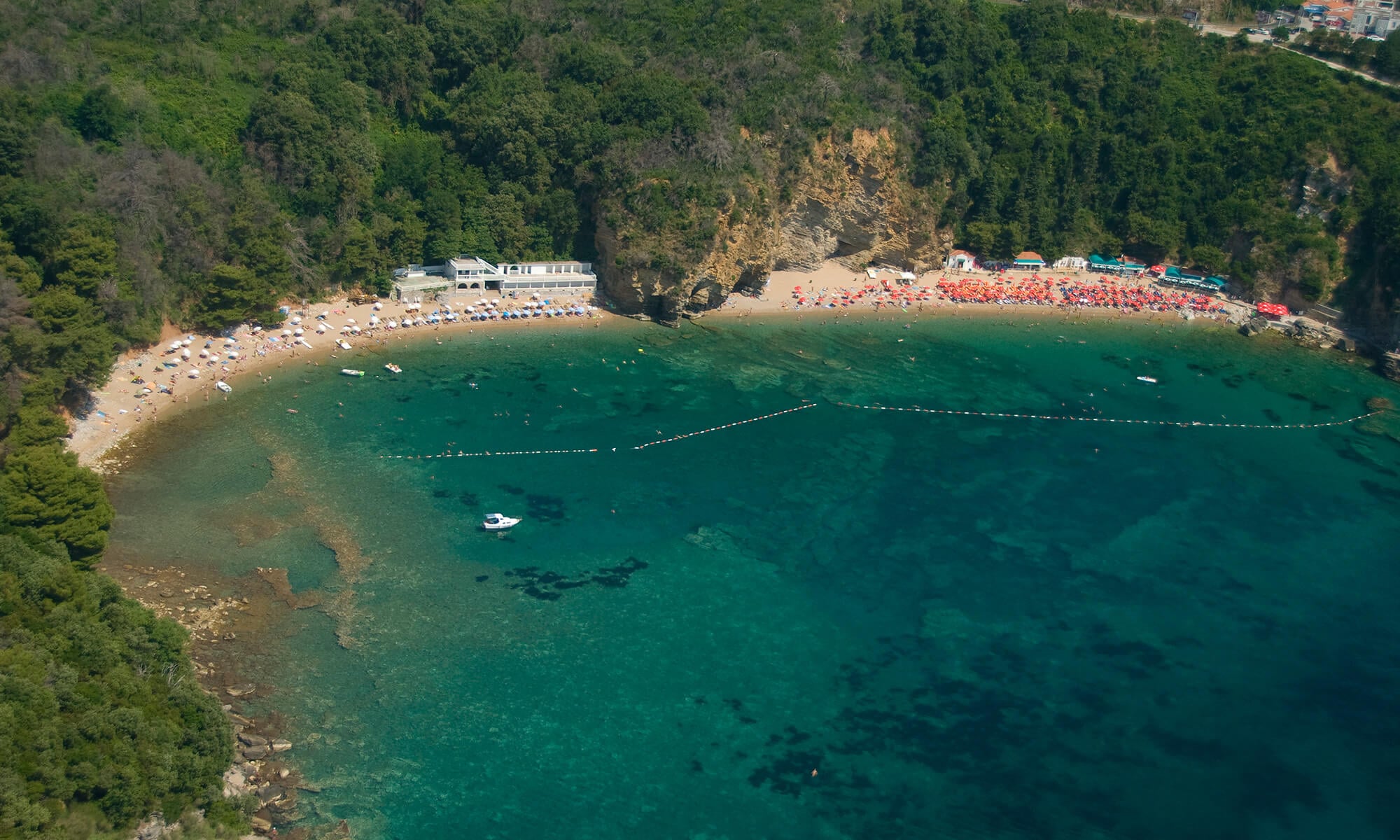
Mogren consists of two beach coves west of the Old Town, below the rocks and linked by a passage through the rock that frames them. From the path beside the sea, you can see rocks close by, small beaches and the town walls behind you, giving a view of Budva's coast that differs from the long town beach.
A concrete path leads from the Avala hotel to the first cove. The tourist organisation gives a length of 350 metres from that starting point. The second cove lies beyond the passage through the rock. Access depends on the state of the sea. During southerly jugo winds and strong waves, water hits the path, and Budva's tourist organisation explicitly warns that the passage is unsafe in those conditions.
Access: The seaside path is unsafe during southerly jugo winds and strong waves. In those conditions, it must not be used to reach the beaches.
Access to MogrenSveti Nikola island
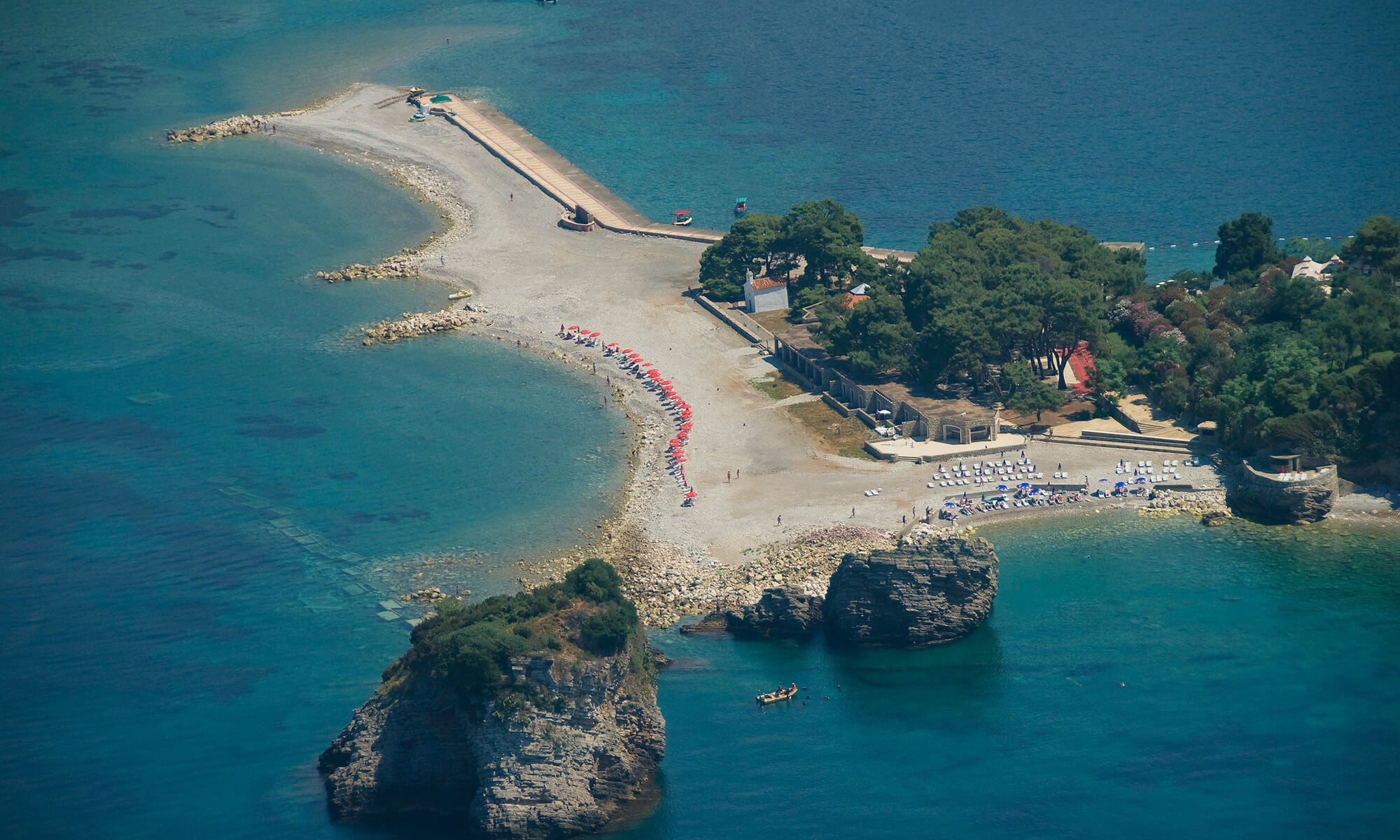
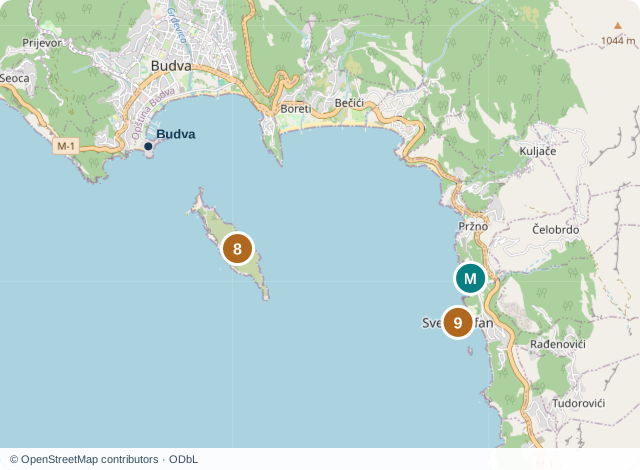
Sveti Nikola island lies opposite Budva and is recognisable from the town shore by its elongated green shape and rocks rising from the sea. The view from its shore turns back towards the mainland, so the Old Town and bay are seen across the water. This is a separate island visit involving a sea crossing, rather than an extension of a town walk.
The island takes its name from the Church of St. Nicholas. Small vessels and boats from Budva carry visitors to the landing pier. On the other side are smaller coves beneath steep rocks, reached by boat. Their proximity on the map does not mean there is a walking route from the beaches by the pier.
Crossing: The landing pier is reached by a small vessel or boat. Arrange departure, the fare, the landing location and the return journey with the specific operator. Exploring the accessible shore does not imply that you can roam freely throughout the island's interior.
Sveti Nikola island04Sveti Stefan and Milocer on the Riviera
Sveti Stefan and Milocer Park
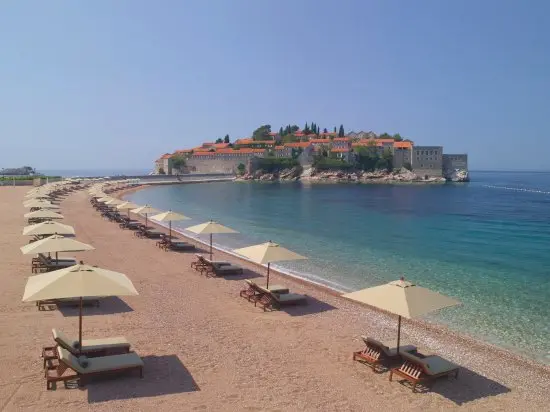
Sveti Stefan is a fortified settlement of stone houses with red roofs, linked to the shore by a narrow land approach southeast of Budva. Its enclosed perimeter above the sea is clearest from the mainland, while nearby Milocer is recognisable by its villa and tree-lined avenues in the greenery behind the beaches. These are places on the Budva Riviera, outside the town's historic centre, with different areas and entry arrangements.
The stone houses of the former fishing settlement were converted into a hotel, which opened in 1960. The settlement takes its name from the Church of St. Stephen on its high ground. The hotel is used as private accommodation, so the appearance of a historic village does not prove that you can walk freely through its streets. Viewing it from the shore and entering the hotel settlement are two different choices.
Milocer Park is behind King's Beach and Queen's Beach, around the former summer residence of the Karadjordjevic family. Cedar, eucalyptus, agave and other species were planted alongside coastal vegetation. Villa Milocer is on the mainland, across the bay from Sveti Stefan, and is now part of the hotel's accommodation offering. Distinguish access to park paths, beaches and the hotel villa, because one open path does not mean that all of those spaces are accessible.
Entry: Aman distinguishes the seasonal hotel area on the island from Villa Milocer on the mainland. Ask for its current terms for a day visit to the island and access to individual hotel spaces.
Aman Sveti StefanWalking between the houses, along the ramparts and into the Citadel does not take place within one continuous visitor area. The higher parts of the defences have a separate entrance.
Choose the City Museum for archaeological and ethnographic objects. The Modern Gallery focuses on art, while Ljubisa's birthplace contains literary and documentary material.
Viewing the fortified settlement from the shore is governed by different conditions from entering the private hotel complex. For a visit inside, you need an answer from its operator.
Similar names for different places
Santa Maria in Punta stands beside the southwestern town wall. Santa Maria de Castello, also known as Santa Maria in Castio, was a church inside the Citadel, and parts of its architecture survive. The name of the church on the promontory does not lead to the same remains.
Mogren beach is beside the sea, approached from the Avala hotel. Mogren Fortress stands above the coast on Spas hill. The beach path therefore does not also lead to the fortification, whose description and access belong to Budva's lesser-known places.
Sveti Nikola is the island facing Budva, reached by boat. Sveti Stefan is another place, further along the Riviera, connected to the mainland by a narrow land approach. Arranging a boat trip to Sveti Nikola therefore does not provide transport to the Sveti Stefan hotel settlement.
Stories behind the icon, paintings and old photographs
The icon of Our Lady of Budva was kept in Santa Maria in Punta until 1807, when it was moved to the Church of St. John. The connection between the two churches is therefore more than their proximity. An object associated with the older church is now kept in another.
The Contemporary Expressionists collection grew from works exhibited in 1972, which the artists subsequently donated to the gallery. Those holdings exist independently of the exhibition open during your visit.
The memorial also holds a collection of photographs gathered by Ante Urban, from the end of the nineteenth century to the end of the twentieth century, including photographs of the 1979 earthquake. Alongside material about the writer, this collection documents changes in the town itself.